

Summarize this article with AI Open a summary of this article in your preferred assistant
If a scratch only breaks the paint, a panel fence does not rust because zinc still covers the steel. On a narrow scratch that reaches the steel, or on a freshly cut wire end, the surrounding zinc holds rust off for a while. That time shortens in harsh climates, so cover exposed steel with zinc-rich paint and then a coat in the panel's color.
Does a panel fence rust? Not if the scratch stops short of the steel. A narrow scratch that reaches the steel and a freshly cut wire end are both protected by the zinc around them for a while. That time depends on the climate, so cover exposed steel with zinc-rich paint and then a coat in the panel's color.
What protects a panel fence from rust?
A panel fence has three layers: steel wire, zinc and powder coating. The zinc sits on the wire because the wire is hot-dip galvanized during production. The outer layer is powder coating, 60 to 110 microns thick, which keeps both water and air away from the zinc. Where the coating tears, the zinc takes over. In the same environment it corrodes about 30 times more slowly than steel, and it wears away in the steel's place (American Galvanizers Association).
What does a scratch mean at each depth?
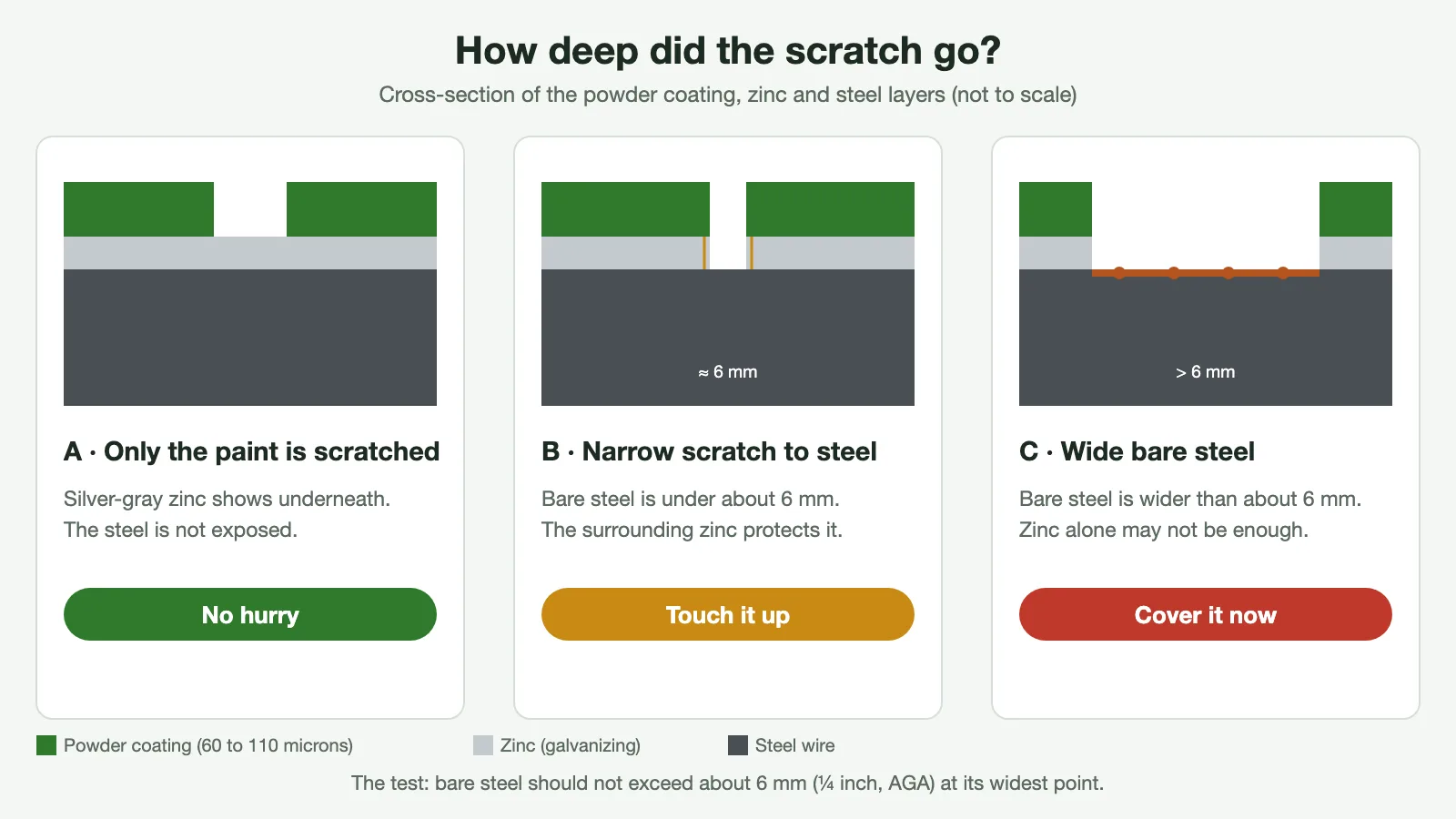
First check which layer the scratch reached. A silver-gray surface under the paint means you are down to the zinc. A dark gray or rust-colored surface is bare steel.
| Scratch | What is exposed | Rust risk | What to do |
|---|---|---|---|
| Only the paint is scratched, with a silver-gray surface underneath | Zinc | The steel is not exposed. The zinc slowly forms its own protective layer. | No hurry. Touch it up if you want to fix the look. |
| The scratch reaches the steel, and the bare steel is under about 6 mm | A narrow strip of steel | The surrounding zinc protects it. Rust starts once that zinc is used up. | Touch it up to extend that time. |
| Bare steel wider than about 6 mm | A wide area of steel | Zinc may not protect an area this wide on its own. | Cover it right away. |
| Post paint scratched down to the steel | The post's steel | The product spec does not say the post is zinc-coated, so do not rely on zinc protection. | Cover it right away. |
The 6 mm limit is the American Galvanizers Association's figure for galvanized steel. If bare steel is no more than about 1/4 inch (6.35 mm) across at its widest point, corrosion does not start until the surrounding zinc is used up. When it does start, it stays in that spot instead of spreading. This is a rule of thumb, not a guarantee, and it holds only while zinc remains.
Does a panel cut on site rust at the end?
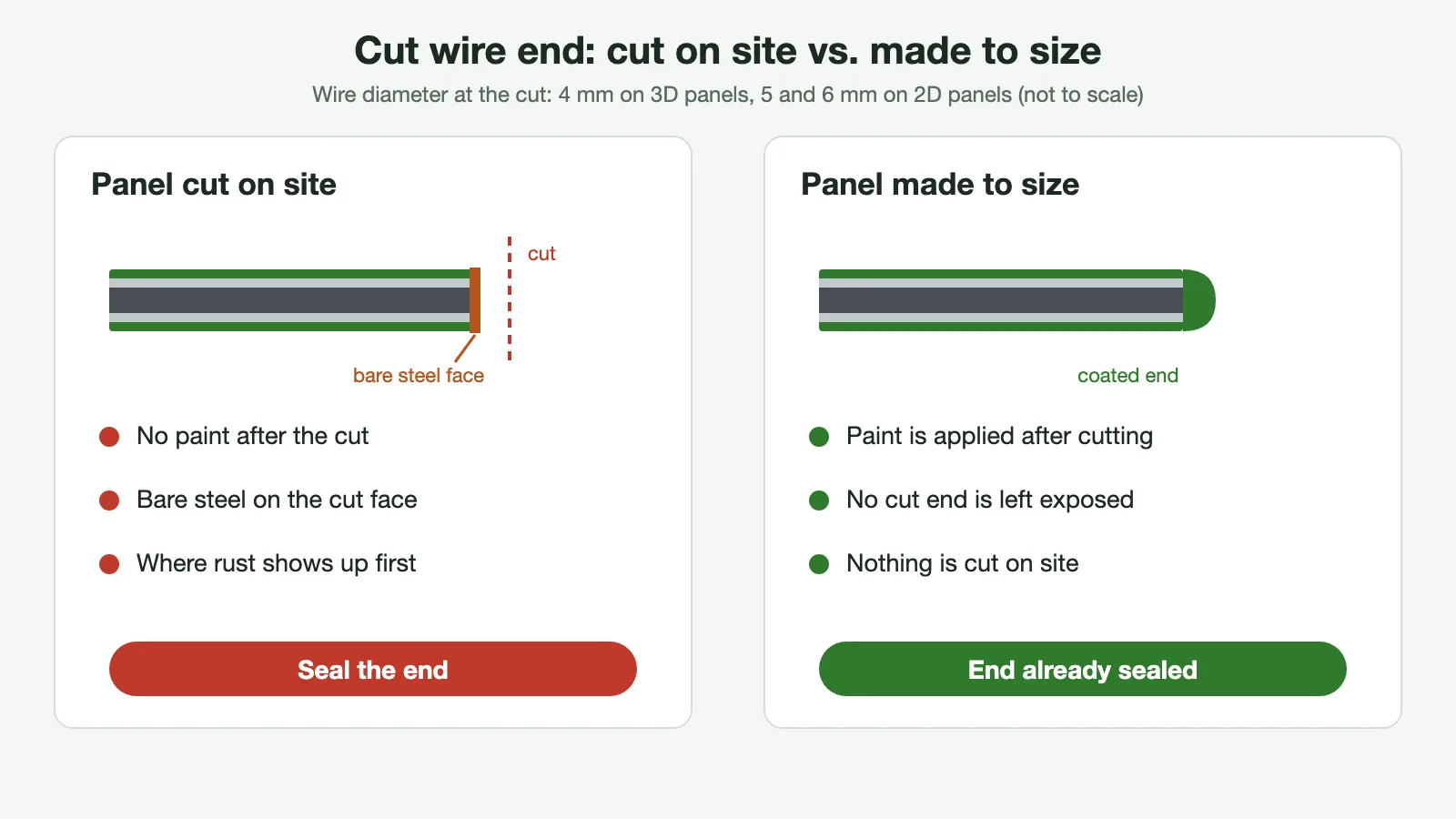
The cut face of a wire has no zinc or paint, so the steel is exposed and rust shows up there first. The cross-section is small: 4 mm wire on a 3D panel and 5 and 6 mm wire on a 2D panel. A limit of 1/4 inch equals 6.35 mm. Those cross-sections fall under it, so the zinc around the end protects it for a while. The 6 mm wire of the 2D panel comes closest to the limit. This is our own reasoning, not a lab measurement, and the result depends on the climate.
On a panel made to size, the paint goes on after cutting, so no cut end is left exposed. If a gap remains at the end of a run, order a panel made to size instead of cutting one on site. The Custom Size Panel Fence page explains how to measure.
How does climate change how fast zinc wears away?
Zinc is the sacrificial metal, and it wears faster as the environment gets harsher. By ISO 9223 class, zinc loses the following in the first year (source: American Galvanizers Association table):
| Environment | ISO 9223 class | Zinc loss (microns per year, first year) |
|---|---|---|
| Rural | C2 | 0.1 to 0.7 |
| Urban | C3 | 0.7 to 2.1 |
| Industrial | C4 | 2.1 to 4.2 |
| Marine | C5 | 4.2 to 8.4 |
| Offshore | CX | 8.4 to 25 |
If your fence is near the sea or in an industrial area, cover scratches without waiting. The zinc thickness of our panels is not recorded in the product spec. If you are planning a coastal fence, ask for this value in the quote and get the answer in writing. Our article on mesh size and panel fence security raises the same question for coastal and humid areas.
How do you seal a scratch or a cut end?
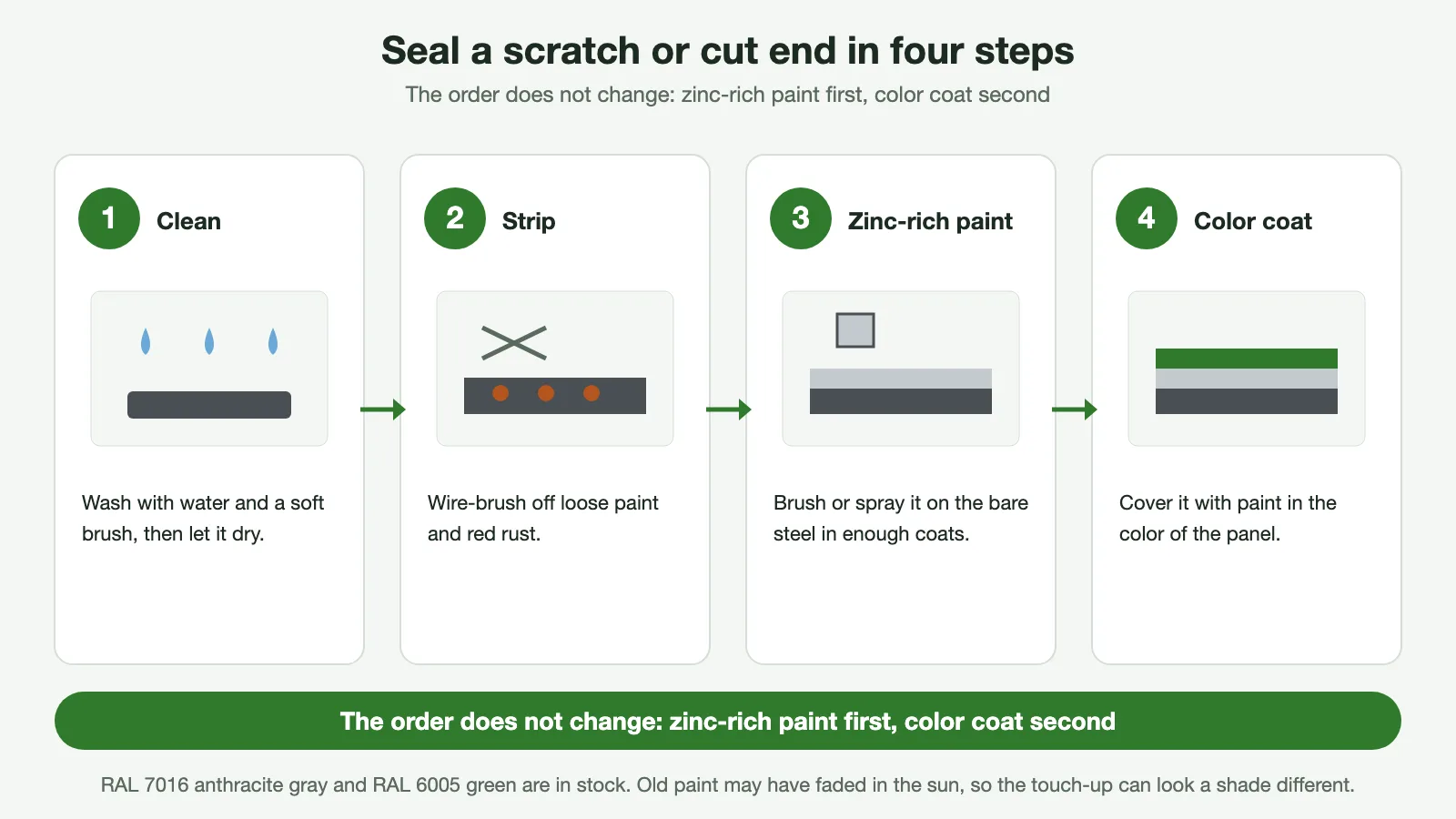
The order does not change: zinc-rich paint first, then a color coat that matches the panel.
Zinc-rich paint is a primer with a high share of zinc dust. Galvanizers also repair damage with a heated zinc rod or thermal zinc spray, but those methods need heat or special equipment. On a painted panel in the field, brush-on or spray zinc-rich paint is easier to apply.
- Wash the surface with water and a soft brush, then let it dry.
- Wire-brush loose paint and red rust off the panel.
- Apply zinc-rich paint to the bare steel. Follow the label for the number of coats and the drying time.
- When the zinc paint is dry, cover it with paint in the panel's color. RAL 7016 anthracite gray and RAL 6005 green are in stock.
Old paint may have faded in the sun. The touch-up will look a shade different for that reason.
Wire-brushing and enough coats of zinc-rich paint come from the Galvanizers Association's repair guidance under EN ISO 1461. That guidance is written for galvanized parts. If the panel's manufacturer gives different instructions, follow those.
Is a scratch on a post more urgent?
Yes, because the product spec lists the post as a 50x50x1.5 mm box section with oven-baked paint and does not mention a zinc coating. Cover a scratch that reaches the steel right away and do not count on zinc protection. The post has its own Panel Fence Post page, and the steel post or concrete post article covers material choice.
What should you ask when buying panels?
- The thickness of the zinc coating on the wire and the galvanizing method
- Whether the post is zinc-coated
- The RAL code of the paint for touch-ups
- Whether a panel can be made to size when your run is not a multiple of the panel width
You can find the options on the 3D Panel Fence and 2D Panel Fence System pages, and every height on the category page. For a quote, send your measurement list and a sketch through the contact page.
Frequently asked questions
Will a scratched panel fence rust right away?
Is ordinary spray paint enough for a touch-up?
What do you put on a cut wire end?
Does a scratched post behave like a scratched panel?
Why does the touch-up look like a different color?
Can I paint over rust that has already started?
Should I check a coastal fence more often?



0 comments
Leave a comment
Your comment will be published after review.