
Summarize this article with AI Open a summary of this article in your preferred assistant
DTEX is a unit of linear density: 1 DTEX means 10,000 meters of yarn weighs 1 gram. In artificial grass it shows how much material the yarn carries, but a higher DTEX alone does not mean better or more durable grass. Assess it together with pile height, fiber density, yarn type, fiber geometry, UV stabilization and area of use. Denier is the weight of 9,000 meters.
In artificial grass, DTEX is the technical measure of the weight of a given length of the synthetic grass yarn used. 1 DTEX means that 10,000 meters of yarn weighs 1 gram. It tells you how much material goes into the yarn and helps you judge its structure.
However, a high DTEX value alone does not mean the artificial grass is better. To assess a product properly, consider DTEX together with pile height, fiber density, yarn shape, yarn material, backing structure, stitch rate, UV stabilization and area of use. When comparing artificial grass models for different applications, looking at these technical parameters together gives a more accurate result.
Jidar Group offers artificial grass for gardens and landscaping as well as football pitches, tennis and padel courts. With that range, we choose products by intensity of use and technical requirements, not by appearance alone.
DTEX does not determine the overall quality of artificial grass on its own. It shows how much material is in the yarn. Assess it together with density, pile height, yarn structure and intended use.
What Is DTEX?
DTEX is a linear density measure used in the textile industry. It expresses how many grams 10,000 meters of a yarn weighs.
For example, if 10,000 meters of a yarn theoretically weighs 1,200 grams, its linear density is expressed as 1,200 DTEX.
For artificial grass, it shows how heavy the yarn behind each grass fiber is over a given length.
| DTEX Value | Basic Meaning |
|---|---|
| 600 DTEX | 10,000 meters of yarn is approx. 600 grams |
| 1,000 DTEX | 10,000 meters of yarn is approx. 1,000 grams |
| 1,200 DTEX | 10,000 meters of yarn is approx. 1,200 grams |
| 1,500 DTEX | 10,000 meters of yarn is approx. 1,500 grams |
The values here are examples to explain how DTEX is measured. The actual technical values of an artificial grass should be stated by the manufacturer in the product specification.
What Does DTEX Mean in Artificial Grass?
In artificial grass, DTEX shows the linear density of the synthetic yarn, meaning the mass of the yarn over a given length.
That makes it one of the figures you can use when comparing artificial grass products.
But there is an important point here: DTEX and fiber density are not the same thing.
A product can have a high DTEX value and still fall short if the fibers sit sparsely on the backing. The reverse also happens. A lower-DTEX yarn can do the job in some applications when the density and design suit the use.
Is DTEX the Same as Yarn Quality?
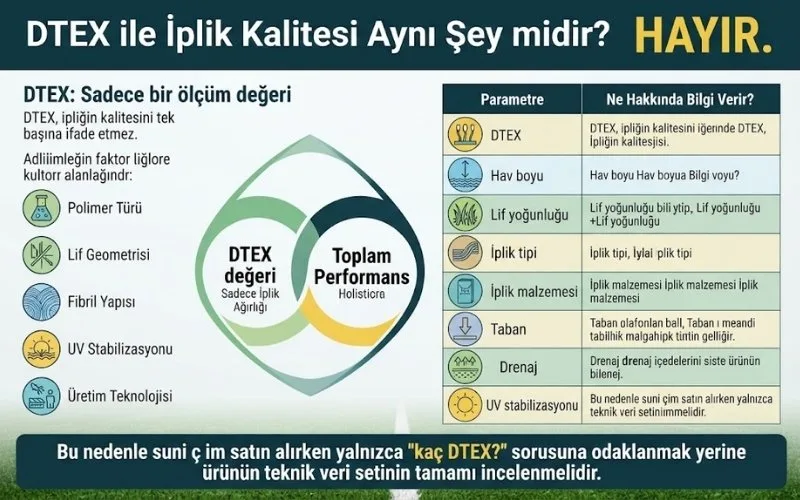
No. DTEX does not express the quality of the yarn on its own.
DTEX is a measured value. The polymer used to make the yarn, fiber geometry, fibrillated structure, UV stabilization and production technology also affect how artificial grass performs.
| Parameter | What It Tells You |
|---|---|
| DTEX | Linear density of the yarn |
| Pile height | Height of the fibers from the backing |
| Fiber density | Amount of fiber per unit area |
| Yarn type | Monofilament, fibrillated, etc. |
| Yarn material | Polymer such as PE or PP |
| Backing | Structure of the backing system |
| Drainage | Ability to carry water away from the surface |
| UV stabilization | Resistance to outdoor radiation |
When you buy artificial grass, look at the full technical data set, not just "how many DTEX?"
Does Higher DTEX Mean Better Artificial Grass?
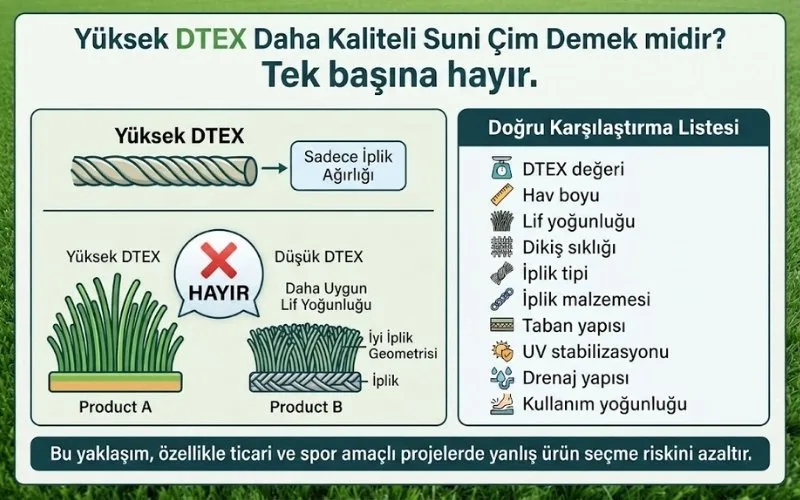
Not on its own. A higher DTEX can indicate that the yarn's linear density is higher, but it does not determine the product's overall performance by itself.
Say you are comparing two artificial grass products and one has the higher DTEX value. The other may still have the fiber density, yarn geometry, backing structure or UV stabilization that better suits your area of use.
A fair comparison covers:
- DTEX value
- Pile height
- Fiber density
- Stitch rate
- Yarn type
- Yarn material
- Backing structure
- UV stabilization
- Drainage structure
- Intensity of use
Checking all of these lowers the risk of picking the wrong product, especially on commercial and sports projects.
How Are DTEX and Pile Height Related?
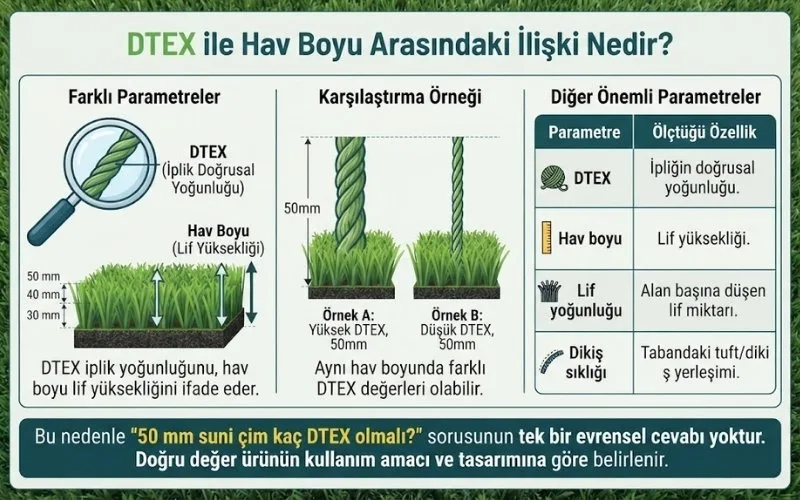
DTEX and pile height are different technical parameters. DTEX expresses the linear density of the yarn, while pile height expresses the height of the artificial grass fiber from the backing.
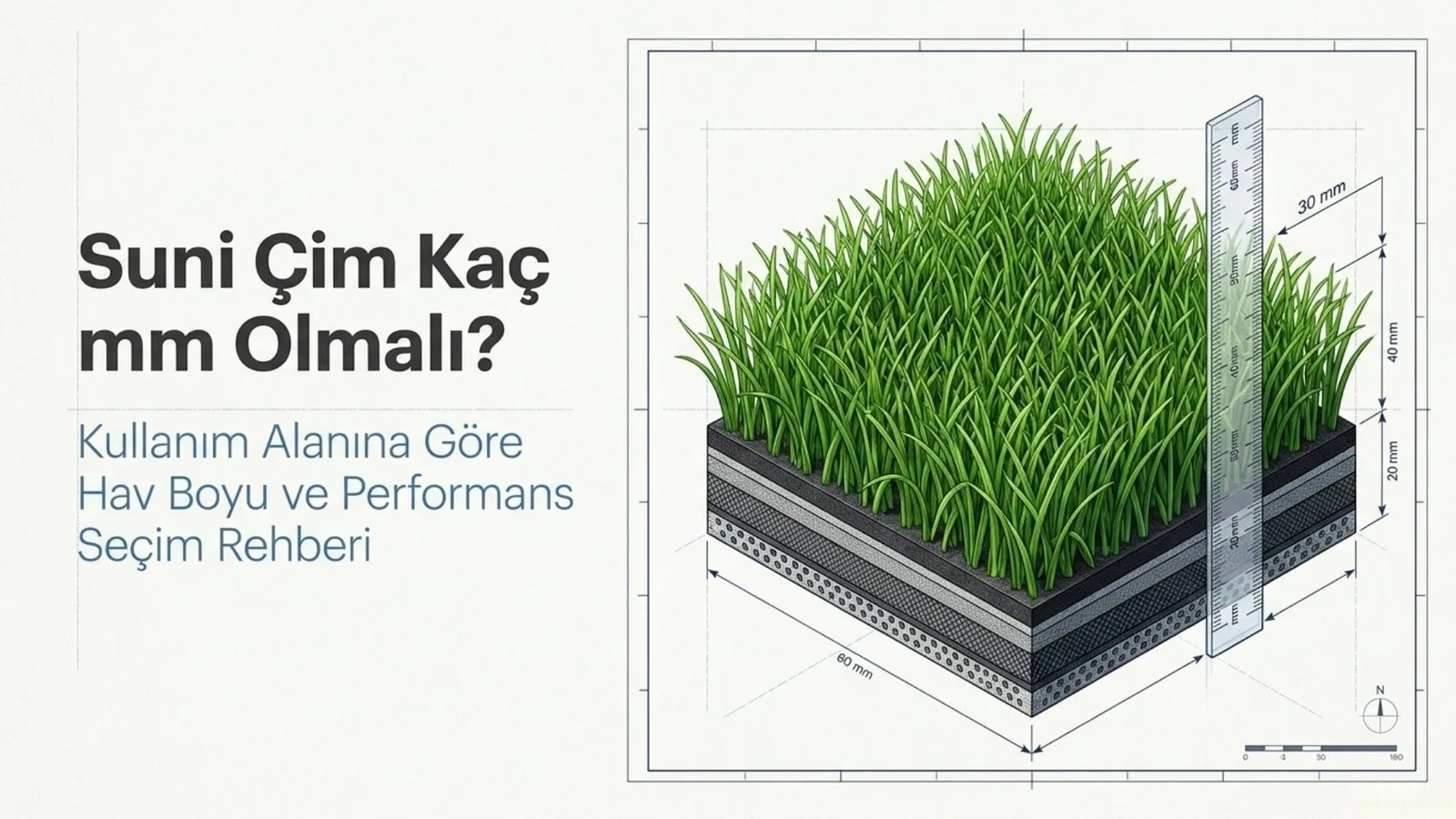
For example, products with a pile height of 30 mm, 40 mm or 50 mm may have different DTEX values. Two products with the same pile height do not necessarily have the same yarn structure and DTEX value either.
| Parameter | Property Measured |
|---|---|
| DTEX | Linear density of the yarn |
| Pile height | Fiber height |
| Fiber density | Amount of fiber per area |
| Stitch rate | Tuft/stitch placement in the backing |
That is why "how many DTEX should 50 mm artificial grass have?" has no single answer. It depends on what the product is for and how it is designed.
DTEX vs. Fiber Density
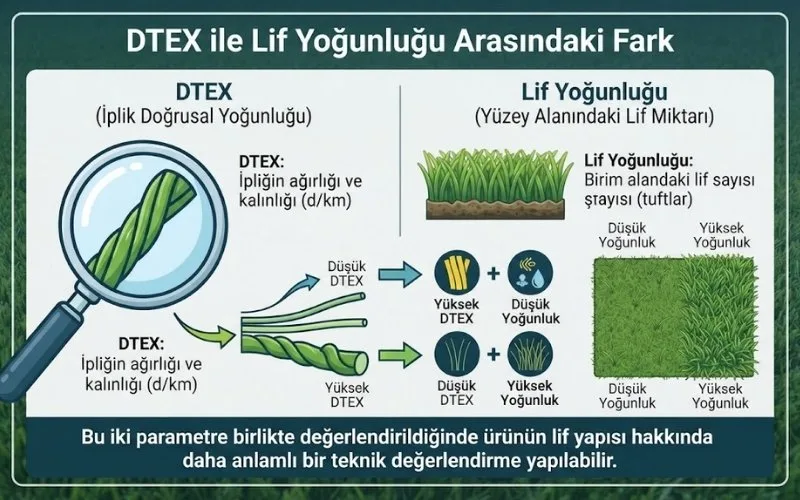
DTEX and density are the two concepts most often confused when choosing artificial grass.
DTEX expresses the linear density of the yarn, while fiber density expresses how much fiber there is in a given surface area.
A high-DTEX yarn can end up in a low-density product, and a lower-DTEX yarn can go into a denser construction.
Read the two together and you get a clearer picture of the fiber structure.
How Is DTEX Assessed by Area of Use?
The table below shows how DTEX is assessed in artificial grass by area of use. Whatever the area of use, the DTEX value alone is not a sufficient selection criterion.
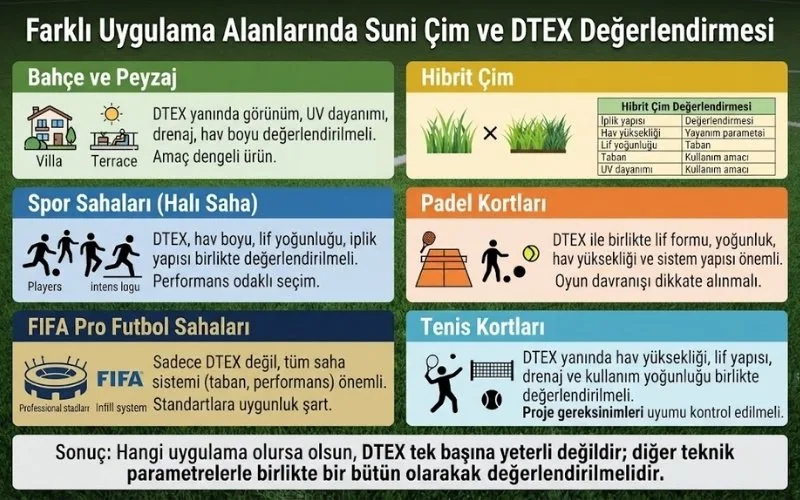
Why Does DTEX Matter in Landscape Artificial Grass?
Garden and landscape grass usually does not see constant foot traffic. Some properties that matter on a sports field matter less in a garden.
When choosing landscape artificial grass, appearance, fiber structure, UV resistance, drainage, pile height and intensity of use should be assessed alongside DTEX.
For example, for products used in a villa garden, terrace or landscaped area, landscape artificial grass options can be reviewed according to the use scenario.
For a garden, look for a balanced product that suits how the garden is used. The highest DTEX value is not the goal.
Why Does DTEX Matter in Football Turf?
A small-sided football pitch puts much more mechanical stress on artificial grass. Players run, turn and slide, the ball keeps moving, and regular maintenance adds its own load on the surface.
Choose football turf by DTEX, pile height, fiber density, yarn structure and pitch design together.
When choosing football turf, take into account intensity of use and pitch performance rather than only how the product looks at first.
In sports artificial grass, DTEX alone is not a sufficient selection criterion. Yarn structure, density, pile height and pitch design should be assessed together.
How Is DTEX Assessed in Football Pitch Artificial Grass?
A professional football pitch calls for a far more technical assessment than a garden. Here you are judging the whole pitch system, not just the DTEX value of the grass.
On football surfaces, pile height, yarn structure, density, infill system, backing structure and pitch performance are assessed together.
When you review professional football products such as Pro Odin artificial grass , look at the full set of technical properties.
At professional sports facilities, or those subject to standards, product selection should not be made as a simple commercial product comparison. The project's relevant pitch standard and performance requirements should be checked separately.
Why Does DTEX Matter in Hybrid Grass?
With hybrid grass, look at the fiber structure and the intended use together. Synthetic fibers used with natural grass, or within a specific system design, bring their own technical expectations.
So when choosing hybrid grass, look at the product's overall system structure rather than assessing the DTEX value alone.
When reviewing hybrid options with different pile heights, compare pile height and intended use together with DTEX.
| Hybrid Grass Assessment | Parameter to Check |
|---|---|
| Yarn structure | Yarn type and linear density |
| Pile height | Fit with the system design |
| Fiber density | Amount of fiber on the surface |
| Backing | Stability and system structure |
| UV resistance | Outdoor use |
| Intended use | Landscaping or sports application |
Does DTEX Matter in Padel Artificial Grass?
Padel courts have their own technical requirements, set by court geometry and how players move. Surface play behavior, ball movement, footing and intensity of use should be assessed together.
So in padel grass, fiber shape, density, pile height and the overall structure of the surface system matter alongside the DTEX value.
When reviewing sports products such as Padeles Curly artificial grass, the DTEX value should be assessed together with the product's other technical parameters.
How Is DTEX Assessed in Tennis Artificial Grass?
On tennis courts, the character of the game and the performance expected from the surface set the technical properties of the grass.
Here too, do not choose by DTEX alone. Look at pile height, fiber structure, density, drainage and intensity of use as well.
When choosing tennis artificial grass, check which court design the product was developed for and whether its technical properties match the project requirements.
Does the DTEX Value Show the Durability of Artificial Grass?
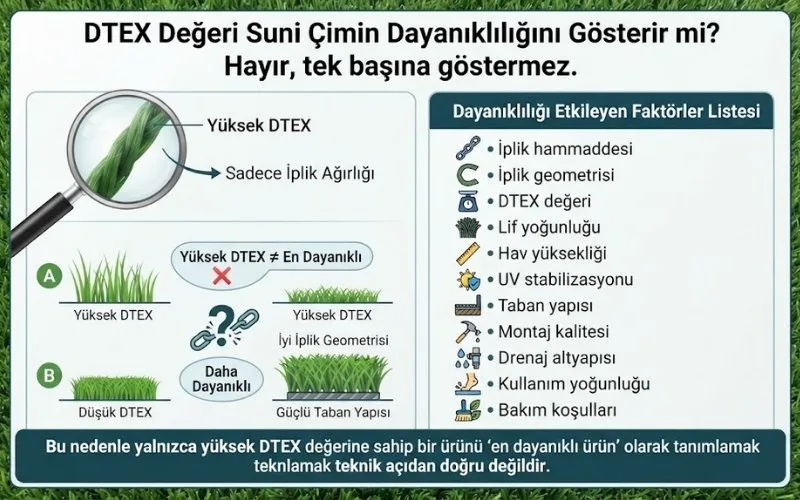
DTEX alone does not give a definite answer on durability. Higher linear density can be an indicator of the amount of material in the yarn, but real-world durability depends on many variables.
For outdoor artificial grass in particular, the following factors should be assessed together:
- Yarn raw material
- Yarn geometry
- DTEX value
- Fiber density
- Pile height
- UV stabilization
- Backing structure
- Installation quality
- Drainage base
- Intensity of use
- Maintenance conditions
Calling a product "the most durable" just because its DTEX value is high is not technically correct.
What DTEX Should You Look for When Buying Artificial Grass?
There is no single numerical answer to this question. The ideal DTEX value depends on where the artificial grass will be used and on the product's overall design.
| Area of Use | DTEX Assessment |
|---|---|
| Garden | Appearance, intensity of use and durability are assessed together |
| Balcony / terrace | Lighter use conditions can be taken into account |
| Small-sided football pitch | Intensive use and sports performance are taken into account |
| Football pitch | The pitch system and performance criteria are assessed together |
| Padel | Game character and surface behavior are taken into account |
| Tennis | Fiber and surface properties suited to court use are reviewed |
A DTEX value alone cannot tell you whether a product suits a garden, football, tennis or padel.
How Is DTEX Calculated?
The basic logic of the DTEX calculation is quite simple. The weight of 10,000 meters of yarn is expressed in grams.
DTEX = Weight of the yarn in grams / length × 10,000
For example, if 20,000 meters of yarn weighs 2,400 grams:
2,400 / 20,000 × 10,000 = 1,200 DTEX
This calculation can be used to understand the unit logic of DTEX. For commercial product assessment, the DTEX value given in the manufacturer's technical documentation should be used.
What Is the Difference Between DTEX and Denier?
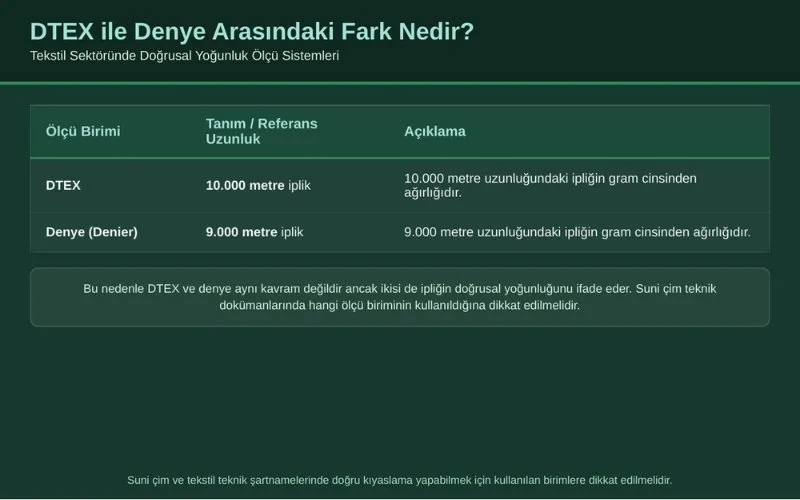
DTEX and denier are two different measurement systems used in the textile industry to express linear density.
| Unit | Definition |
|---|---|
| DTEX | Weight in grams of 10,000 meters of yarn |
| Denier | Weight in grams of 9,000 meters of yarn |
The two units are not interchangeable, even though both describe the linear density of the yarn. When you read artificial grass technical documents, check which one is used.
Jidar Group's Technical Approach to DTEX Selection in Artificial Grass

The right artificial grass is the one that fits its intended use and the project conditions. It is not always the one with the highest technical values.
In Jidar Group's approach, DTEX is assessed together with pile height, density, yarn structure, backing, drainage and area of use. We install artificial grass for gardens, small-sided football pitches and sports areas across Türkiye.
You can compare product groups for anything from a garden installation to a professional sports pitch. Choose by how the grass will really be used, not by catalog values alone.
Need to compare products with different technical properties, or find the right artificial grass for your project? Share your project details through the Jidar Group contact page.
Reading DTEX Alongside Other Artificial Grass Specs
DTEX is an important technical parameter that shows the linear density of artificial grass yarn. It expresses the weight in grams of 10,000 meters of yarn and can be used when assessing the product's yarn structure.
However, DTEX alone does not determine the quality or durability of artificial grass. For the right product choice, assess pile height, fiber density, yarn type, polymer structure, backing system, UV stabilization, drainage and intensity of use together with DTEX.
When buying artificial grass, ask "which technical combination is right for this project?" before you ask "which one has the highest DTEX?"
To review artificial grass products by area of use, browse the Jidar Group artificial grass category. For help choosing a product for your project, ask Jidar Group for technical information.
Frequently asked questions
What is DTEX in artificial grass?
Is higher DTEX better in artificial grass?
What DTEX should artificial grass have?
Are DTEX and pile height the same?
What is the difference between DTEX and density?
Does higher DTEX make artificial grass more durable?
Does DTEX matter in football turf?
Does DTEX matter in landscape artificial grass?
What is the difference between DTEX and denier?
Is it right to look only at DTEX when choosing artificial grass?


0 comments
Leave a comment
Your comment will be published after review.