

Summarize this article with AI Open a summary of this article in your preferred assistant
To cover a chain link fence for privacy, tie a grass fence roll to the inside of the mesh with cable ties or galvanized wire, top edge first, then the bottom and the middle. Match the roll height to the fence, choose the narrowest mesh for the densest screen, and check the posts first, because a covered fence takes much more wind load. Jidar Group grass fence comes in 10 m rolls.
To cover a chain link fence for privacy, tie a grass fence roll to the inside of the mesh with cable ties or galvanized wire, top edge first, then the bottom and the middle. Use a roll as tall as the fence and the narrowest mesh. Check the posts first: a covered fence takes much more wind.
What a grass fence roll is made of
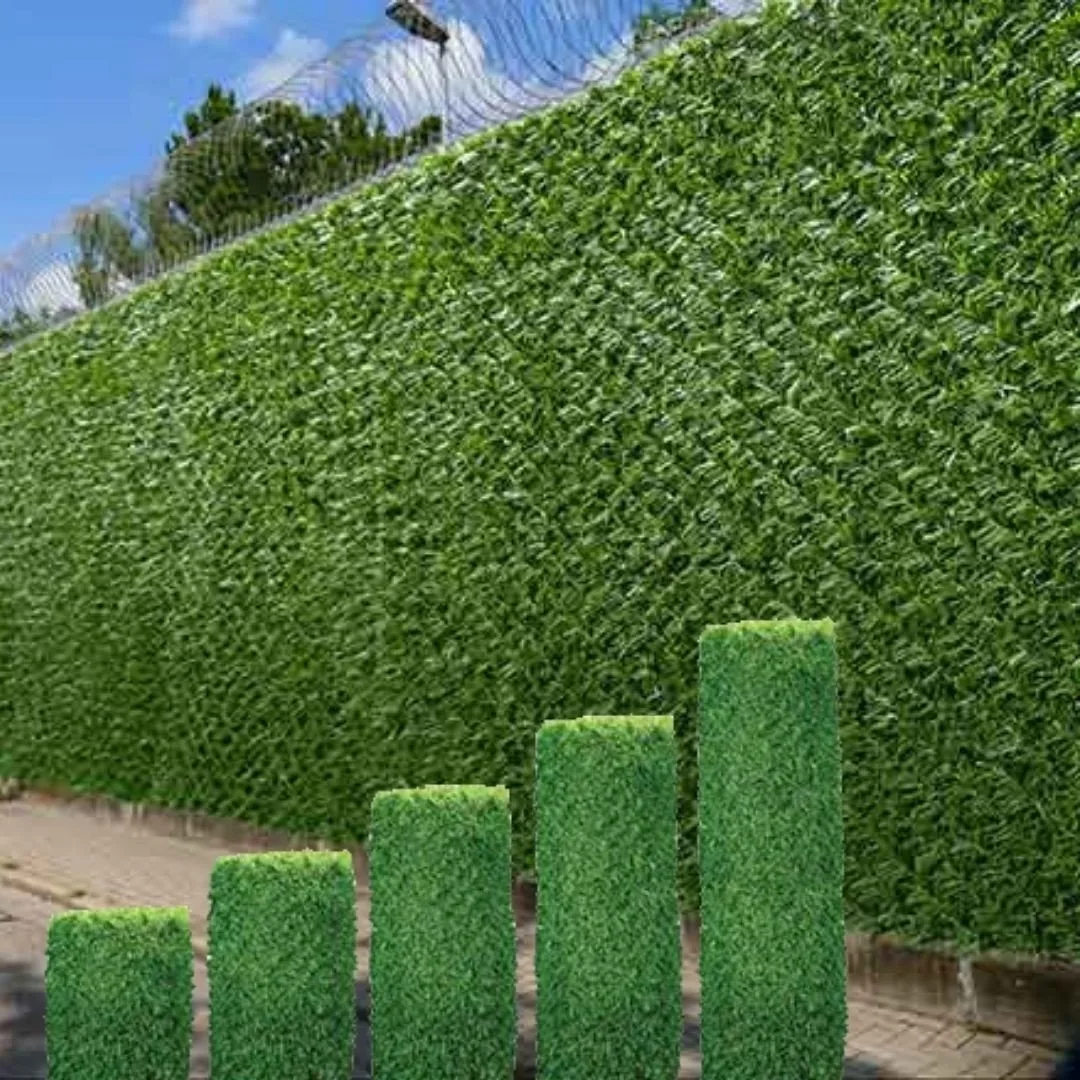
A grass fence is a roll of synthetic grass fibres on a galvanized steel wire carrier. The fibres are UV resistant, and the fence needs no watering or mowing. Our rolls are 10 metres long and come in 100, 120, 150 and 200 cm heights, and we make other heights and lengths to order.
Leaf grass fence works the same way with PVC ivy leaves instead of grass fibres. The leaves contain a UV additive, the galvanized wire carrier is 2 × 1.6 mm with a 45 mm mesh opening, and the finished fence looks like a hedge.
Match the roll height to the fence
Use a roll the same height as the chain link, so the screen does not stick out at the top or leave a gap at the bottom. Chain link sold in feet converts like this:
| Chain link height | Grass fence to use |
|---|---|
| About 100 cm (3 ft 3 in): low garden fences, balcony railings | 100 cm Grass Fence |
| 4 ft (122 cm) | 120 cm Grass Fence |
| 5 ft (152 cm): side and back garden boundaries | 150 cm Grass Fence |
| 6 ft (183 cm) | Custom Size Grass Fence, made to the fence height |
| About 200 cm (6 ft 7 in): blocks the view of a standing adult | 200 cm Grass Fence |
Choose the density and colour
Grass fence comes in three mesh sizes: 42x42 mm, 46x46 mm and 50x50 mm. The smaller the mesh, the denser the grass texture and the less you can see through it. For a neighbour boundary, or anywhere you want full screening, choose 42x42 mm, the densest option.
The standard colours are green, anthracite gray, blue and white, and other colours can be made to order. Anthracite grass fence matches gray facades and anthracite panel fences; colored grass fence is used at schools, playgrounds and sports facilities.
Count the rolls
Measure the whole run, including corners and gate openings. Divide the length by the 10 m roll length and round up: a 37 m run needs 4 rolls. Note corners and gates separately, because each one is covered with its own piece.
To work out the area, multiply the height by 10 m. A 100 cm roll covers 10 m², a 150 cm roll 15 m² and a 200 cm roll 20 m².
Check the posts and wind load first
Open chain link lets the wind pass through. Once it is covered, the wind pushes on the whole surface, and that load goes to the posts and the top rail or tension wire. The taller the fence, the bigger the load.
A grass fence closes the open surface of the mesh, so the posts now carry the wind that used to pass through it.
Before you install, straighten or replace leaning posts and retighten loose tension wire. Chain link holds its shape by tension, and once a post leans the mesh starts to sag. On 200 cm runs and on open, exposed sites, have the post size and spacing checked by someone who can see the site.
Fixing the roll to the chain link
- Unroll the grass fence along the inside face of the chain link, with the fibres facing out and the top edge level with the top of the fence.
- Tie the top edge to the top rail or tension wire at short intervals with UV-resistant cable ties or galvanized wire.
- Pull the roll taut and tie the bottom edge.
- Add rows of ties across the height. Ties placed close together and evenly spaced stop the screen from flapping and rubbing in the wind.
- Join two rolls at a post, so the joint is harder to see, and tie both edges.
- End the roll on the corner post and start a new piece, and cover gates separately so they still open freely.
Our step-by-step guide to installing artificial grass fence panels covers a new fence from the posts up, and grass fence on panel fences covers welded panels.

Grass fence, leaf fence or a new panel fence?
| Option | Look | When it fits |
|---|---|---|
| Grass fence roll | Even green surface; density set by the mesh size | Most chain link fences in sound condition |
| Leaf grass fence | Hedge look with ivy leaves | Gardens, terraces and cafe fronts where a hedge look is wanted |
| Green wall fence | Grass surface over a solid wall | Concrete and block walls, and old wire fences |
| New panel fence plus a screen | Rigid, straight line | Chain link that sags, has rusted or keeps losing tension |
If the chain link is past repair, our comparison of panel fence and wire mesh fence explains the difference. A welded panel can then take a grass fence or a PP fence privacy strip.
Grass fence rolls from Jidar Group
Jidar Group produces grass fence at its facility in Bolluca, Arnavutköy, Istanbul. For a quote, send the length of the run, the fence height, the colour and mesh density you want, and the delivery location through our contact page.
Frequently asked questions
Can you see through a grass fence?
Less with a narrower mesh. The 42x42 mm option gives the densest grass texture; the 46x46 mm and 50x50 mm options are more open.
Can a grass fence roll be cut to length?
Yes. Cut the grass with a sharp knife and the wire carrier with side cutters, then tie the cut end to a post.
Does a grass fence need maintenance?
It needs no watering or mowing. Check the ties after the first windy spell, replace any that have snapped, and rinse off dust with a hose when needed.
Which colours does grass fence come in?
Green, anthracite gray, blue and white as standard. Other colours can be made to order.


0 comments
Leave a comment
Your comment will be published after review.