
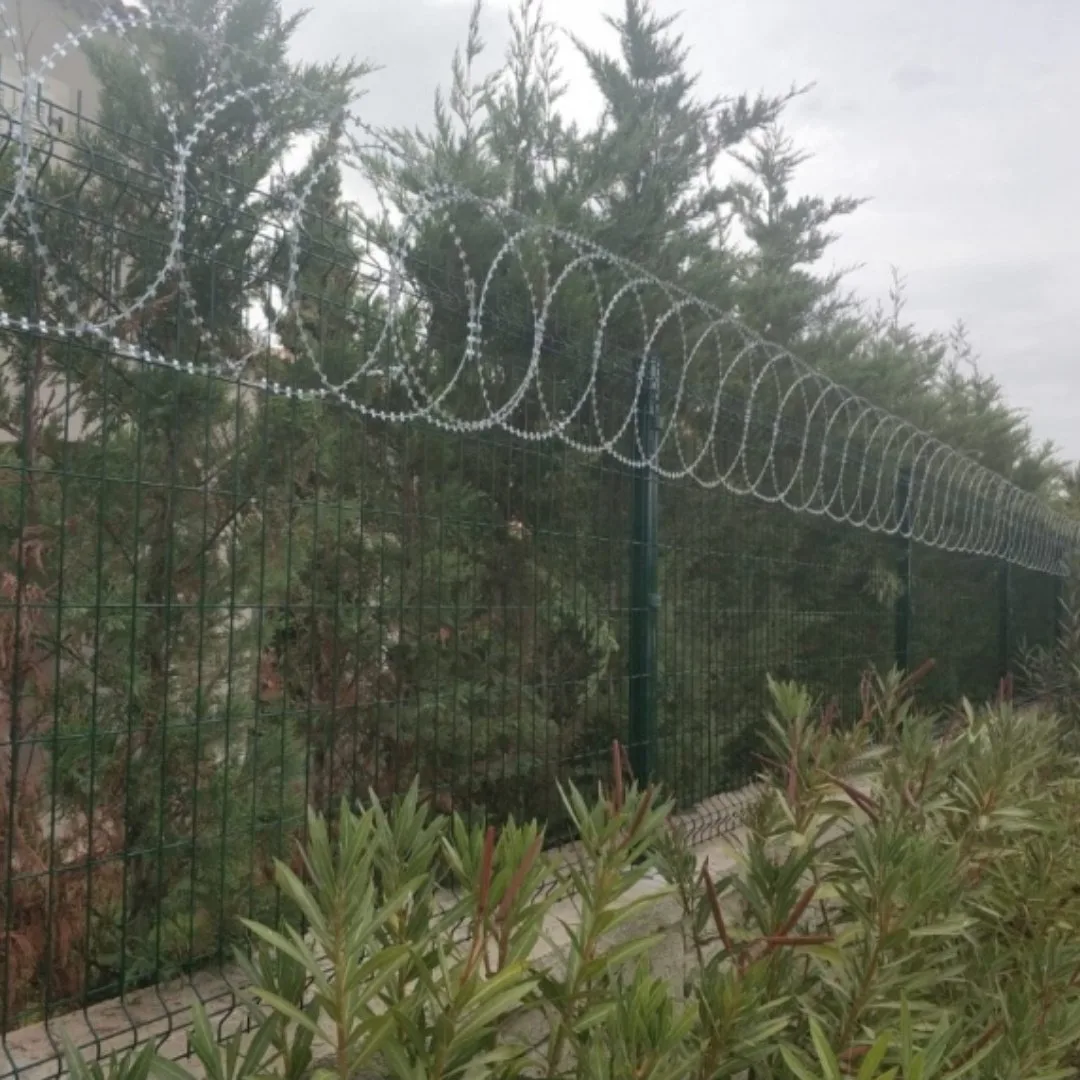
Install a 45 cm razor wire spiral on a wall top without brackets, a 60 cm spiral between the arms of V or Y brackets on a panel fence, and a 90 cm flat strip over a fence or wall face. The guide covers each position, the fitting order, safety gear and a final checklist.
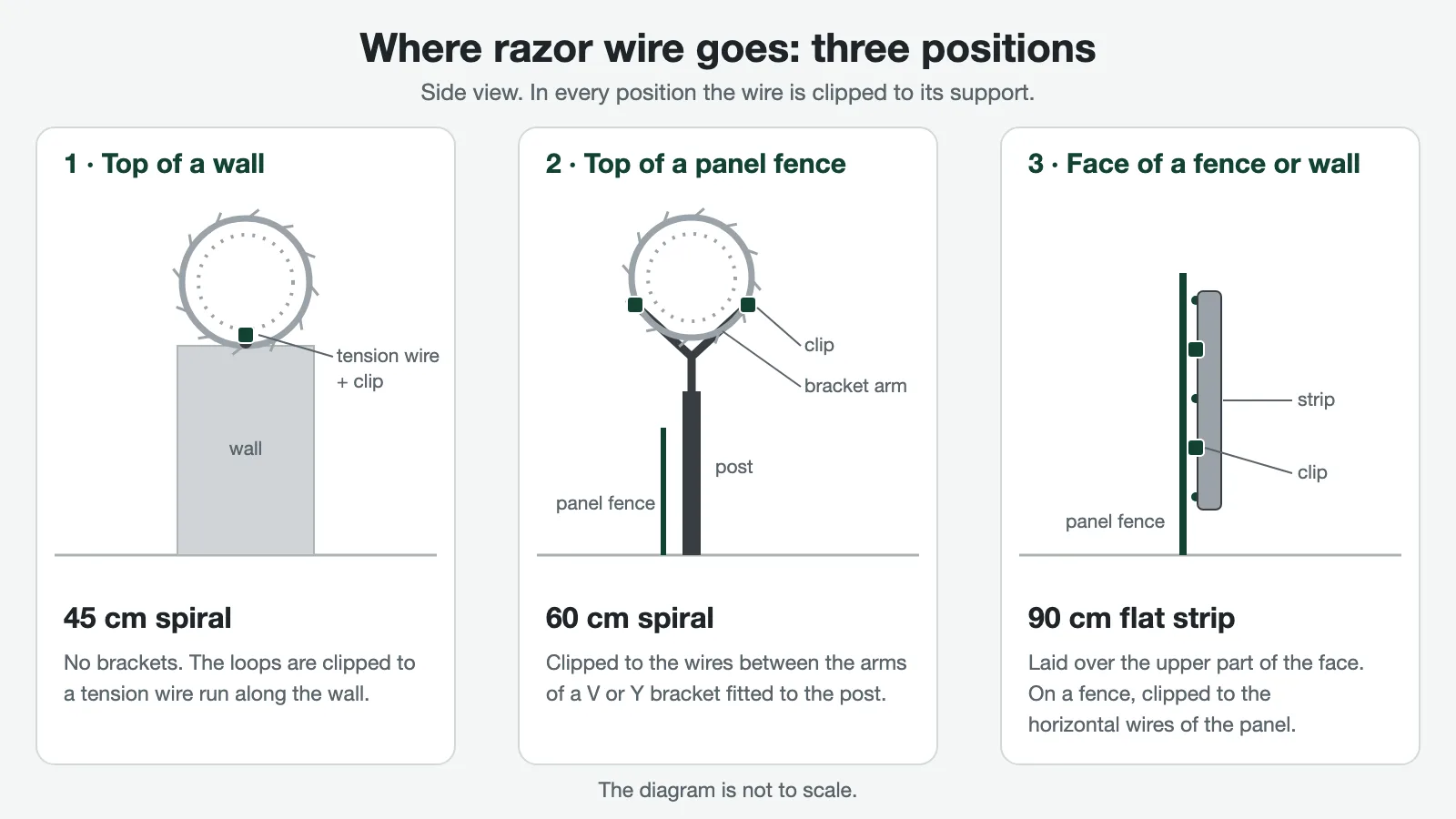
How you install razor wire depends on where it goes. A 45 cm spiral lies on top of a wall without brackets, a 60 cm spiral sits between the arms of a V or Y bracket on a panel fence, and a 90 cm flat strip is laid over the face of a fence or wall. In all three you prepare the support first, clip the loops to it, and fix the ends last.
Some local authorities restrict razor wire on garden walls, so ask yours before you start. We cover how those decisions differ in Is Razor Wire Legal in Türkiye?
Which razor wire goes where?
The coil diameter and the shape of the wire decide the position. A spiral opens into a bulky barrier and spreads sideways. A flat strip has its coils flattened and overlapped in one plane, so it stays on the face of a fence or wall, or in line with a gate leaf. All six of our razor wires use 2.5 mm core wire, 0.5 mm blade strip and a hot-dip galvanized finish. They differ in diameter and shape.
| Position | Product | How it is fixed |
|---|---|---|
| Top of a wall, single row | 45 cm Spiral Razor Wire | No brackets. The loops are clipped to a tension wire run along the wall. |
| Top of a panel fence, may reach past the fence line | 60 cm Spiral Razor Wire | Clipped to the wires strung between the arms of V or Y brackets on the posts. |
| Top of a panel fence, in line with the fence | 60 cm Flat Razor Wire | Clipped to straight extension uprights on the posts and to the tension wires between them. |
| Face of a fence or wall | 90 cm Flat Razor Wire | On a fence, clipped to the horizontal wires of the panel. On a wall, held by anchored fixings and tension wires. |
| Top of a sliding or swing gate | 45 cm Flat Razor Wire | Sits on the top edge of the gate leaf, in line with it. |
| On the ground, in front of or behind a fence | 90 cm Spiral Razor Wire | Extended on the ground. The loops are tied to stakes driven into the soil and to wire strung between them. |
Summarize this article with AI Open a summary of this article in your preferred assistant
How do you install razor wire on top of a wall?
On top of a wall, the 45 cm spiral is laid in a single row with no brackets. The 45 cm coil diameter fits a narrow wall coping, and the wire goes on concrete or block walls and on the top edge of an existing fence.
First you run a tension wire along the wall. Then you extend the coil in one row on top of the wall and clip the loops to that wire. The wall face needs no separate support, and the loops stay clearly visible from outside.
On a garden wall, check your local authority's rules before you buy. Razor barbs cut a person climbing the wall, and they also cut a child, cat or bird that comes near. Where the wire must not reach over to the neighbor's side of a narrow coping, the 45 cm flat strip is the one to use.
How do you install razor wire on a panel fence?
On a panel fence, a 60 cm spiral sits between the arms of a V or Y bracket fitted to the posts. Wires are strung between the arms, and the loops are clipped to them. On a Y bracket the coil sits between the two arms, directly above the post. On a V bracket the arms also hold it in the middle.
The bracket count follows the post count. Every post carries a bracket, so the spacing between brackets equals the post spacing, which is 250 cm for a standard panel. Our Panel Fence Post is a 50x50 mm box section with a 1.5 mm wall. The weight of the spiral rests on top of the post, so choose a sturdy bracket. To work out how many posts and brackets a whole perimeter needs, see How to Estimate Panels, Posts and Razor Wire for a Perimeter Fence.
A single-arm bracket angles the wire out beyond the fence. If it would hang over a neighboring lot or a sidewalk, plan for that before you order brackets.
When the wire has to stay in line with the fence, use the 60 cm flat strip. You fit straight extension uprights to the posts and run tension wires between them, then clip the strip to both. If one side of the fence faces a sidewalk, a walkway or a neighboring lot, look at this type first. Because the strip stays on the fence line, a long run comes out as a straight line at a constant height.
If the panel fence stands on top of a wall, the posts are flanged ones fixed with anchors. On soil, the posts are set in concrete. You will find the panels in our panel fence range, and the post material question is covered in our steel post or concrete post article.
Flat razor wire on the face of a fence or wall
The 90 cm Flat Razor Wire is laid over the face of a panel fence, chain link fence or wall, and it covers the part a climber would grip. A flat strip keeps its loops circular in one plane, so the loop diameter gives its height. Fitted vertically on the top edge of a fence, it adds to the fence height.
On a fence you clip the strip to the fence wire or to the horizontal wires of the panel. On a wall, anchored fixings on the surface and tension wires hold it. Because it stays on the face, it does not narrow the path in front of the fence.
The main decision is which face it goes on. A strip on the outward face meets anyone who starts to climb. If that face looks onto a road or walkway, though, the barbs are also close to passers-by. In that case, fit the strip on the inner face or on the top edge of the fence.
The order to follow when you fit the wire
Wear protective gloves, long sleeves and eye protection while you handle the wire, and have at least two people carry and extend the coil.
- Decide the line and the face of the razor wire. Which side will it face, will it reach over a neighbor or a sidewalk, and does your local authority have a rule? Answer these first.
- Build the support. That means the tension wire on a wall, the brackets or extension uprights on a panel fence, and the fixing points on a fence or wall face.
- Tension the wires, but do not over-tighten them.
- Extend the razor wire along the line and clip the loops to the support.
- Fix both ends of the line to a solid point.
Keep razor wire out of arm's reach. On a face that looks onto a sidewalk or road, the barbs should never sit at the height of someone walking past.
Checklist once the wire is up
Walk the whole line after fitting the razor wire and check the following:
- No loop hangs free. Every one is clipped to the wire or the upright.
- The tension wire is neither slack nor over-tight, and the ends are fixed.
- Every bracket is firmly fitted to its post.
- The wire does not reach into a neighbor's lot, a sidewalk or a road.
- No barb is left exposed at a height a hand can reach.
- Warning signs hang along the line.
What to send for a quote
For a quote, go to our contact page and send the length of the line, whether the wire goes on a wall, a panel fence or a fence face, the wall construction, and the number of posts if it is going on a panel fence. We supply razor wire in 45, 60 and 90 cm coil diameters, in spiral and flat types. You will find every option in the Razor Wire category.
Frequently asked questions
Can razor wire go on top of a garden wall?
Can I add razor wire to a fence that is already standing?
What razor wire goes on top of a gate?
Can razor wire be laid on the ground?
Should razor wire go on top of the fence or on its face?




0 comments
Leave a comment
Your comment will be published after review.