
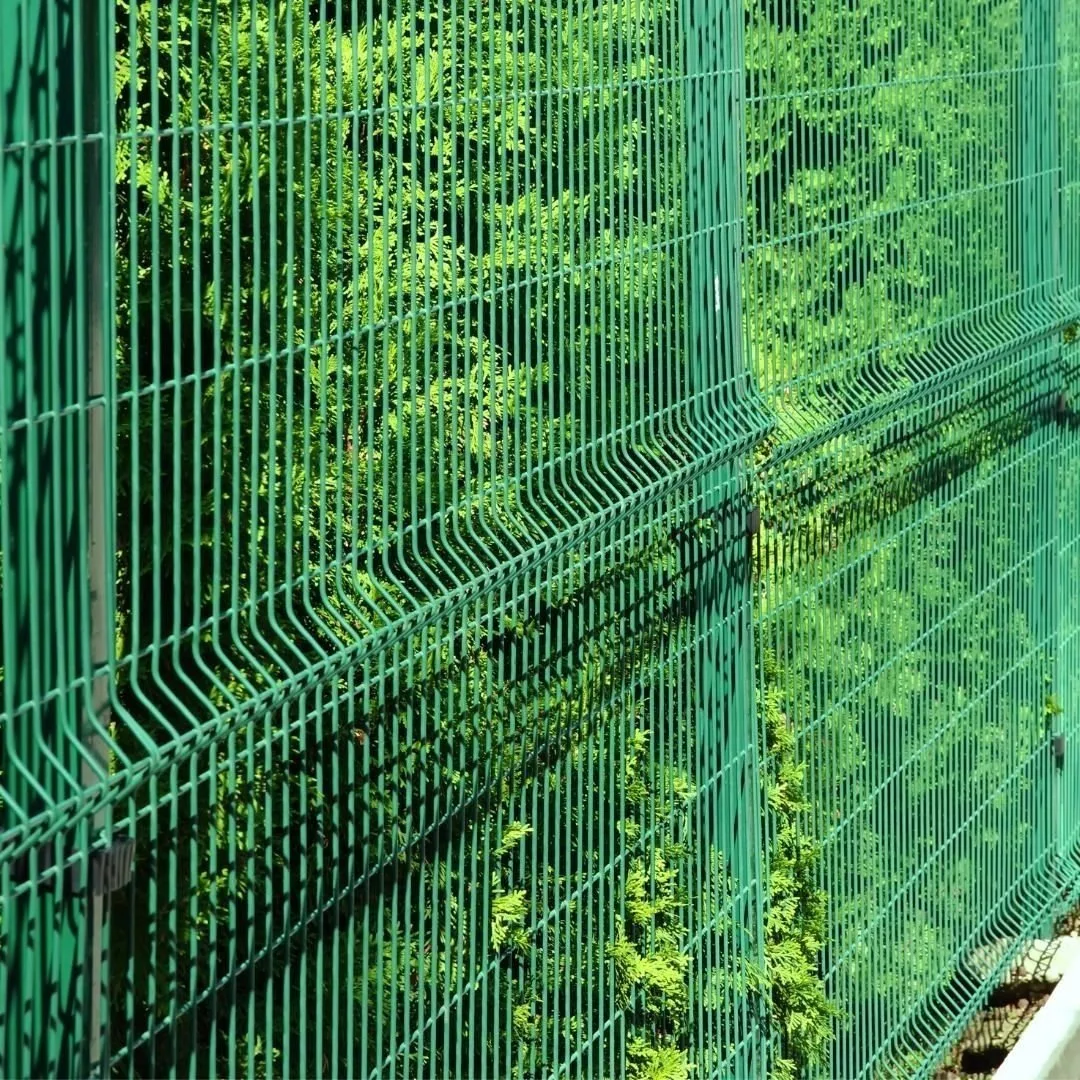
To install a panel fence, you measure the line, set the posts and clamp the panels to them. A post in soil is set in concrete, and a flanged post on concrete or on a wall top is fixed with anchors. The article gives post lengths, the corner, gate and slope work, and a checklist.
To install a panel fence, you measure the line and set the posts first, then clamp the panels to the posts and fit a plastic cap on top of each one. In soil, a post is set in concrete. On concrete ground or on top of a wall, a flanged post is fixed with anchors.
The posts are 50x50 mm box section, spaced as far apart as a standard 250 cm panel is wide. You can choose the panels themselves on the panel fence page. Installation starts with the ground, because the ground decides the post type and length.
Which post goes in which ground?
An in-ground post goes in soil, and a flanged post goes on concrete and on top of a wall. Both are oven-painted 50x50 mm box section with a 1.5 mm wall. The difference is the base.
| Ground | Post type | Post length | How it is fixed |
|---|---|---|---|
| Soil | In-ground post | Panel height plus burial depth | Set in concrete |
| Concrete ground | Flanged post | Equal to the panel height | Flanged base fixed with anchors |
| Wall top | Flanged post | Equal to the panel height | Flanged base fixed with anchors |
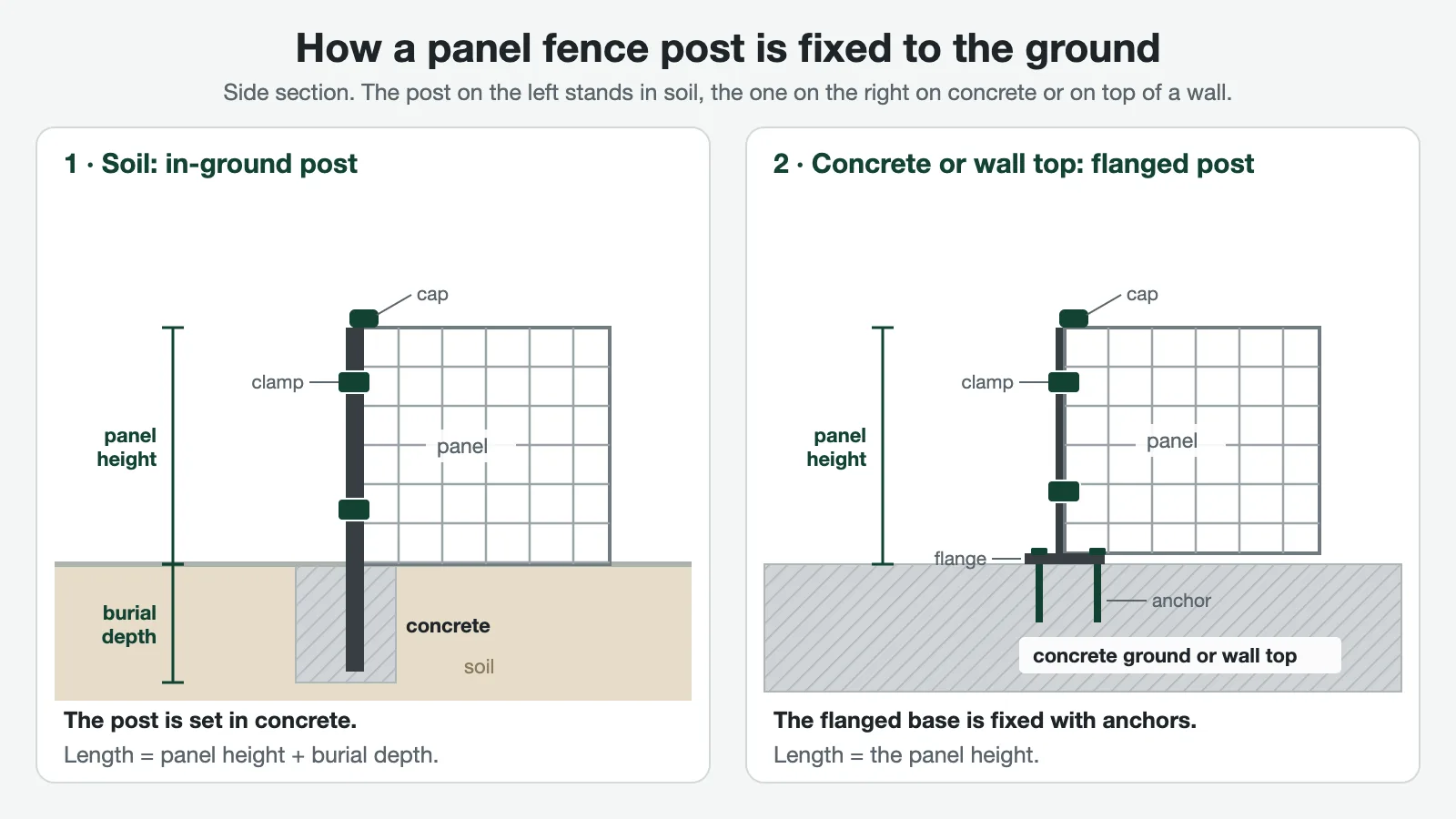
Post lengths are 100, 120, 150, 200 and 240 cm, and the panel height and the ground decide which one you need. We agree the burial depth with you based on the ground and the wind. Whether the post is steel or concrete is covered in steel post or concrete post.
Summarize this article with AI Open a summary of this article in your preferred assistant
How do you measure the line and space the posts?
Posts are spaced as far apart as the panel is wide. The standard panel is 250 cm wide, so the spacing is 250 cm as well. If a panel has a different width, the spacing matches that width.
Measure between post centers, not from the edge of a post. Measuring from the edge makes the panel come out short.
On a straight line you need one more post than panels. Add one post for each corner and two gate posts for each gate. If the line ends in a gap that does not fit 250 cm, a Custom Size Panel Fence closes it and you need one more post. A closed perimeter counts differently, and how to estimate panels, posts and razor wire for a perimeter fence works through it.
How do you install a panel fence step by step?
Setting the posts and clamping the panels goes in this order:
- Measure the line and mark the corners, the gate positions and the type of ground. If the ground changes along the line, note which section takes which post.
- Mark the post positions at panel-width spacing, measuring from centers.
- Set the posts. In soil, set each post in concrete and check that it is plumb, at the right height and on the line before the concrete sets. On concrete or on a wall top, fix the flanged base with anchors.
- Clamp the panels to the posts.
- Fit the plastic cap on top of each post.
Corner and gate posts
A corner takes an extra post, and the two panels that meet there are both fixed to it.
A gate hangs on the gate posts on either side of the opening, so the weight of the leaf and the strain of opening and closing land on those posts. Measure the clear opening between the two gate posts. The standard pedestrian gate is 100 cm wide, and you pick its height to match the fence: 100, 120, 150 or 200 cm. For vehicle access we make sliding and swing gates to order. The ground where the leaf swings must be level, because a ramp or a step makes the leaf drag. Our Panel Fence Gate page covers the measuring in more detail.
Sloping ground and the end of the line
On sloping ground the panels are set in steps, which creates a level difference at each post. Measure the distance from the bottom edge of each section to the ground separately. When a standard panel does not fit a section, Custom Size Panel Fence is made to the size of that section.
The same fix works for a narrow gap at the end of the line that does not fit 250 cm. Ordering a panel to fit gives a cleaner result than cutting one on site, because a panel cut on site leaves bare ends. A panel made to size is coated after cutting, so no bare end remains. We cover cut ends and rust in does a panel fence rust. On top of a wall, measure the height from the top edge of the wall.
The plastic cap and security on top
A plastic cap goes on top of the post. If you need extra security on top, razor wire goes above the panels and is held by brackets fitted to the posts. How each wire is fitted is in how to install razor wire on a wall or panel fence.
Checklist once the fence is up
Walk the line and look for these:
- Post spacing equals the panel width.
- The posts stand plumb and the line runs straight.
- Every panel is clamped to its post.
- The anchors on the flanged posts are fixed in place.
- Each step on sloping ground is closed with a panel of the right size, and no cut end is left bare.
- The gate leaf opens and closes without dragging.
- Every post has its cap.
If we install it for you
With our Panel Fence Installation service we install the panels, posts and gates across Türkiye. We also send the material without installation.
For a quote, send us the line length, panel height, ground type, number of corners and gates, the level differences if the ground slopes, and the color through the contact page. RAL 7016 anthracite gray and RAL 6005 green are in stock. You can find the panels on the 3D Panel Fence and 2D Panel Fence System pages and the posts on the Panel Fence Post page.
Frequently asked questions
Do you need concrete for a panel fence?
Are corner and gate posts a different product?
Can I buy a panel fence without installation?
What should I check about installation before buying a panel fence?




0 comments
Leave a comment
Your comment will be published after review.