
Summarize this article with AI Open a summary of this article in your preferred assistant
Choose pile height by where the grass goes. On balconies and terraces short pile is practical and easy to clean, and in gardens medium pile gives a natural look. For football and hybrid sports surfaces, long pile such as 50-60 mm is considered, depending on product class. Height alone does not measure quality, so weigh yarn type, dtex, density and backing together.
How many mm should artificial grass be? There is no single right answer. It depends on where the artificial grass will go and how hard it will be used. The look you want, what you expect from the surface and the product's fiber structure also count. Gardens, balconies, terraces, sports pitches and commercial spaces rarely suit the same pile height. Pile heights are usually grouped into short, medium and long fibers. The millimeter figure alone will not pick the product for you. One 40 mm product can differ from another 40 mm product in yarn type, dtex, density, fiber shape and backing structure, so the two will perform differently. So start with the question "where and how will it be used?" before "how many mm?".
What Is Pile Height in Artificial Grass?
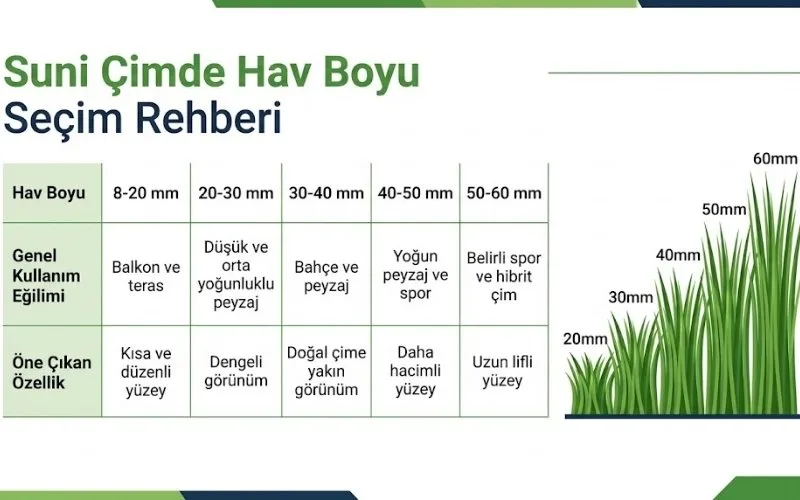
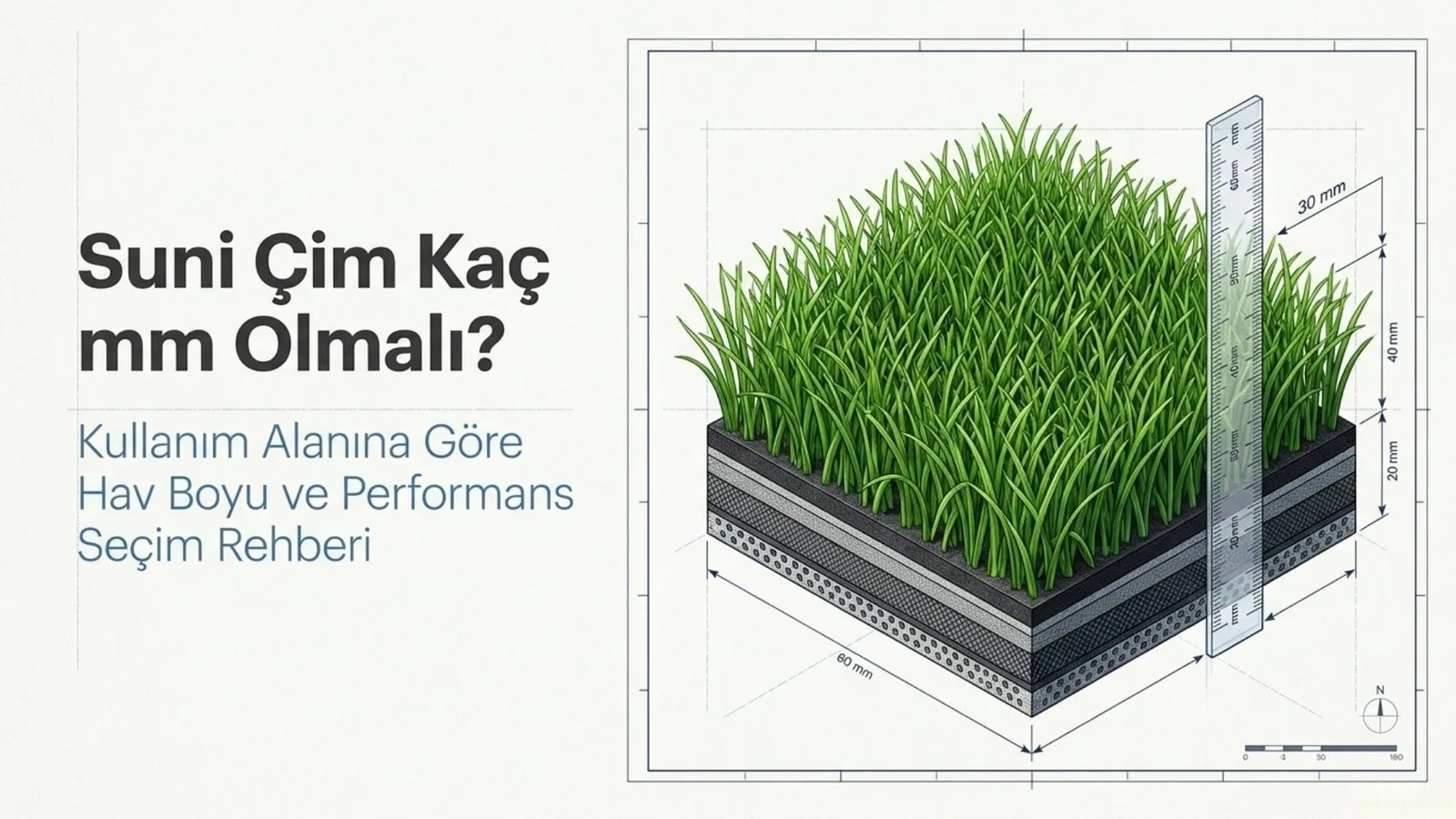
Pile height is the height of the artificial grass fibers above the backing and is usually given in millimeters (mm). A product described as 20 mm, 30 mm, 40 mm, 50 mm or 60 mm is essentially telling you the fiber height.
Taller fibers change the volume and texture of the surface. They do not always mean higher quality or greater durability. The pile height has to suit what the product is for.
| Pile Height | General Use Pattern | Key Feature |
|---|---|---|
| 8–20 mm | Balconies, terraces and decorative installations | Short, even surface |
| 20–30 mm | Low to medium intensity landscaping | Balanced look and easy use |
| 30–40 mm | Gardens and landscaping | Look close to natural grass |
| 40–50 mm | High-use landscaping and some sports installations | Fuller surface |
| 50–60 mm | Certain sports and hybrid grass installations | Long-fiber surface character |
These ranges are not a fixed product classification. Products with the same pile height can have different purposes and technical properties.
Where Is 20 mm Artificial Grass Used?
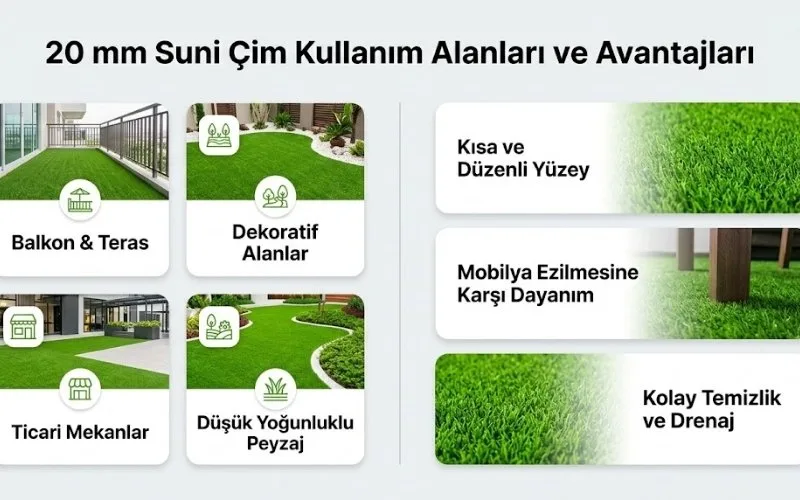
Short pile suits places where you don't need a deep surface: balconies, terraces, decorative areas and some commercial interiors.
Products around 20 mm usually give a shorter, more even surface. On a balcony or terrace with furniture, crushed fibers also tend to show less than they would with a long pile.
Still, pile height is only part of the picture on a balcony or terrace. Check the ground drainage, the installation method, the product weight and the intensity of use as well.
Is 30 mm Artificial Grass Suitable for a Garden?
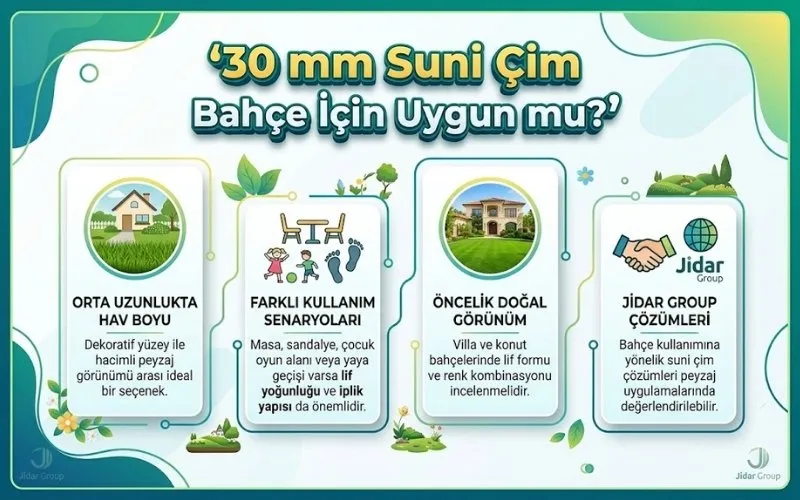
30 mm artificial grass can be considered for garden and landscaping installations that call for medium-length fibers. This pile height can be an option between a very short decorative surface and a long, full landscaping look.
If the garden has tables and chairs, a children's play area or regular foot traffic, check the fiber density and yarn structure as well as the look.
In villa and residential gardens, where a natural look usually comes first, look at the fiber shape and color combination along with the pile height. For this kind of landscaping, Jidar Group's artificial grass for garden use range is a good place to start.
Does 40 mm Artificial Grass Look Natural?
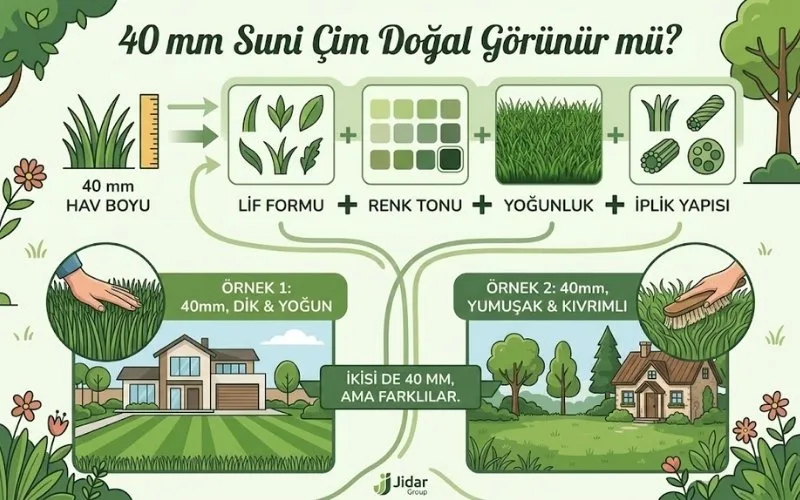
Around 40 mm is a common choice in landscaping projects that want a full lawn close to natural grass. Height alone won't make it look natural, though.
Think of it as natural look = pile height + fiber shape + color tone + density + yarn structure.
Take two products with the same 40 mm pile height. One has more upright, denser fibers. The other has softer, curled fibers. Once installed, they will not look the same.
What Is 50 mm Artificial Grass Used For?
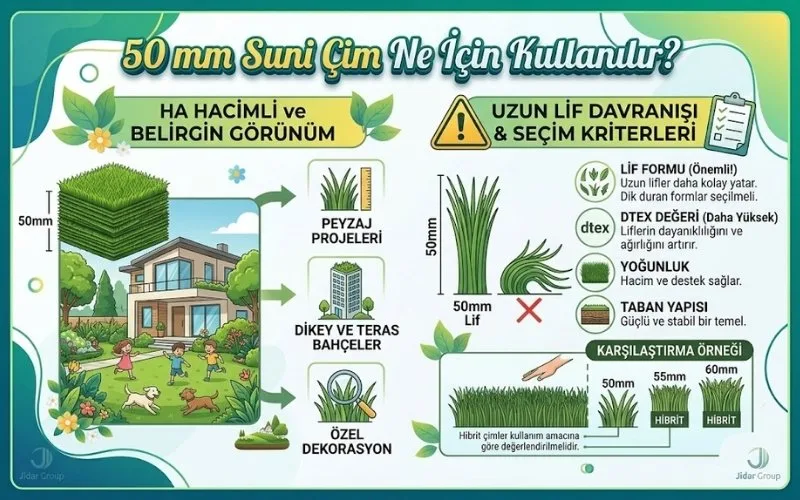
Products around 50 mm give a fuller, more prominent grass look. At this height, how the fibers behave in use matters more.
Long fibers flatten more easily if the product is wrong for the job or the conditions of use don't suit it. With a 50 mm product, check more than the pile height. Look at the fiber shape, dtex value, density and backing structure.
Is 60 mm Artificial Grass Suitable for Every Area?
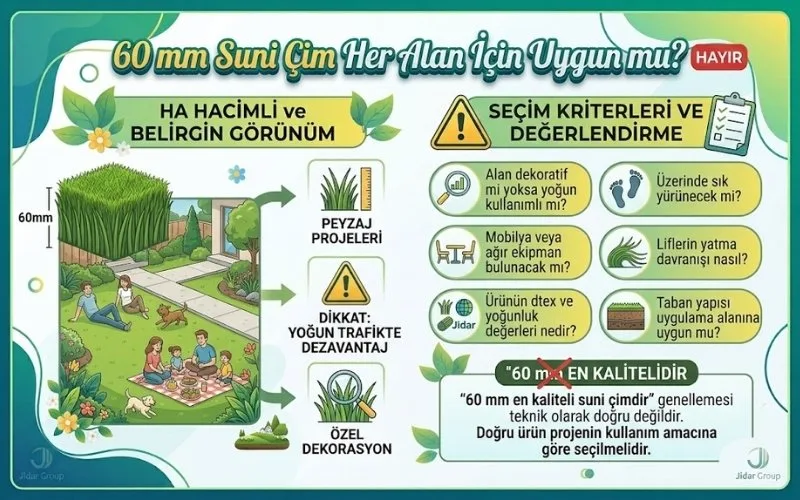
No. A 60 mm pile height is not automatically the better choice for every garden or landscaped area. The full look of long fibers helps in some projects. Heavy foot traffic or other conditions of use may call for different technical properties.
Before choosing a 60 mm product, answer these questions:
- Is the area decorative or heavily used?
- Will people walk on it often?
- Will there be furniture or heavy equipment on it?
- How do the fibers behave when flattened?
- What are the product's dtex and density values?
- Does the backing structure suit the application area?
The idea that "60 mm is the highest-quality artificial grass" does not hold up technically.
How Many mm of Artificial Grass Should You Buy for a Garden?
Most garden projects can look at medium and long-pile options. Base the pile height on how the garden is used, not just on its size.
| Garden Use | Pile Height to Consider | Priority Criterion |
|---|---|---|
| Decorative garden | 30–40 mm | Natural look |
| Villa garden | 30–50 mm | Look and durability |
| Heavily used garden | 30–50 mm | Fiber strength and density |
| Commercial landscaping | 30–50 mm | Look, maintenance and intensity of use |
Treat these values as a starting point. Check the product's other technical properties before you make the final choice.
How Many mm of Artificial Grass for a Balcony or Terrace?
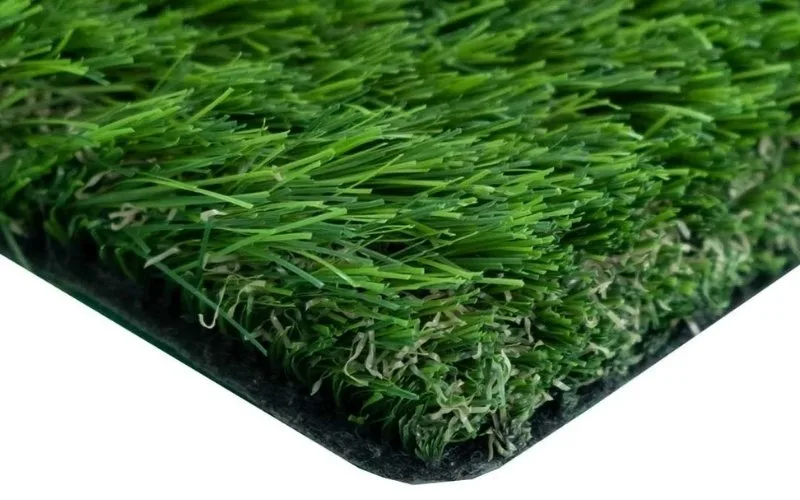
On balconies and terraces, shorter or medium-pile artificial grass is often a practical option. These spaces are used differently from a garden.
Tables, chairs, coffee tables and plant pots keep the fibers under constant pressure. A very long pile is usually a poor fit here. A more balanced surface works better.
Here, product weight, backing structure, drainage and the method of installation on the surface matter as much as pile height.
How Many mm Should Football Pitch Artificial Grass Be?
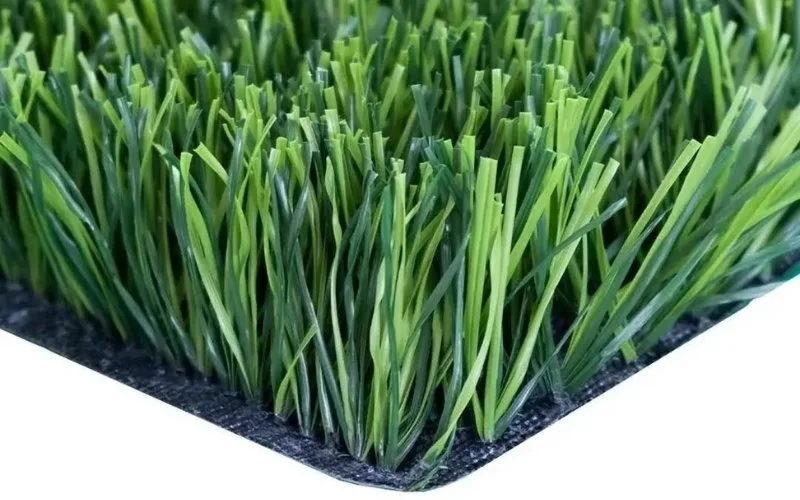
Football turf uses different technical criteria from landscaping. On a pitch, fiber length is judged together with the infill system, the pitch base, intensity of use and the product's sports performance.
There is no fixed rule like "a football pitch needs 50 mm artificial grass." You have to look at the entire pitch system.
For professional or heavily used football pitches, check the technical properties of football pitch artificial grass products against how the pitch will be used.
Is Pile Height a Sufficient Criterion for Football Pitch Artificial Grass?
No. On a professional football pitch, pile height alone is not enough. Pitch performance is assessed together with the surface system, fiber structure, infill, base and the relevant test criteria.
Beyond the millimeter figure, ask which pitch standard and conditions of use the product suits.
With a professional pitch product such as Pro Odin artificial grass , examine its technical properties for pitch use alongside the pile height.
How Is Pile Height Evaluated on Padel and Tennis Courts?
Padel and tennis courts are a different job from garden landscaping. The surface has to work with sports equipment and player movement as well as look right.
On padel courts, fiber shape and surface character matter a lot. Purpose-built products such as curled-fiber artificial grass developed for padel courts should be judged separately from standard garden grass.
Tennis courts are similar. Pile height is one factor. How the court is used and how the surface performs matter too. Review tennis court artificial grass solutions against the project requirements.
What Is the Difference Between 55 mm and 60 mm Hybrid Grass?
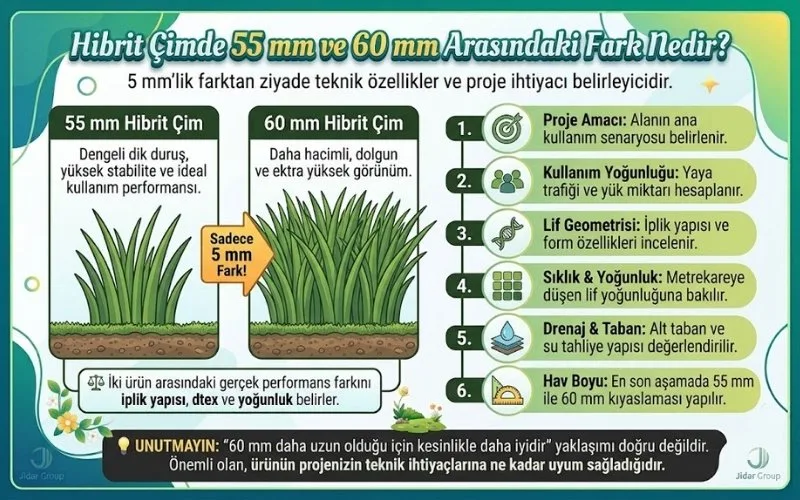
The difference between 55 mm and 60 mm pile heights is only 5 mm. Don't choose on that difference alone. Yarn structure, density, fiber geometry and purpose of use can say more about how the two products really perform.
To choose between 55 mm and 60 mm, work through these steps:
- Define the project's purpose of use.
- Estimate the expected intensity of use.
- Compare yarn and fiber properties.
- Examine product density.
- Evaluate the backing and drainage system.
- Finally, compare pile heights.
Skip the "60 mm is definitely better because it is longer" reasoning and check whether the product suits the project's needs.
Is Long Pile or Short Pile Better in Artificial Grass?
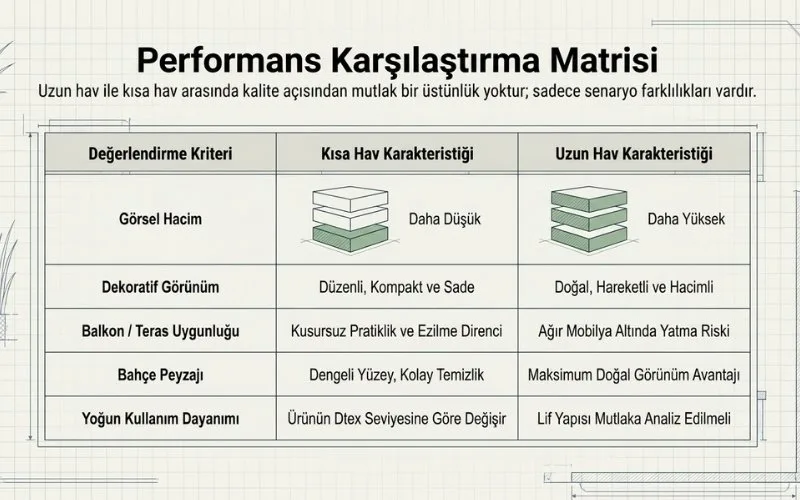
Neither is better in absolute terms. Each pile height has its own advantages in use.
| Comparison | Short Pile | Long Pile |
|---|---|---|
| Visual volume | Lower | Higher |
| Decorative look | Neat and simple | More natural and full |
| Balcony/terrace | Usually practical | Evaluated by use |
| Garden | Suitable options exist | Can offer a natural-look advantage |
| Intensive use | Depends on the product | Fiber structure should be examined separately |
Which Properties Should You Check Along with Pile Height When Choosing Artificial Grass?
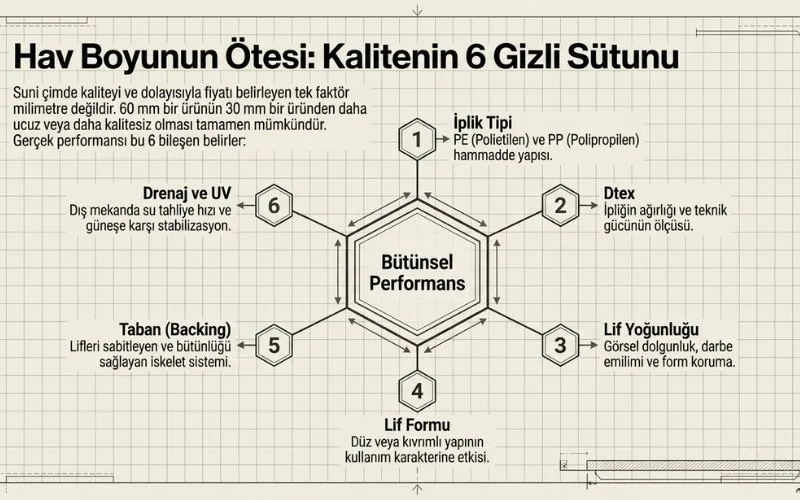
Pile height is important but not enough on its own to choose a product. Products with the same pile height can perform differently in use.
Yarn type
PE and PP yarns give the surface a different character. Pick the yarn structure to suit the purpose of use.
Dtex
Dtex is one of the main figures for judging the yarn structure. Read it together with pile height.
Fiber density
Fiber density on the surface matters for visual fullness and character in use.
Fiber shape
Straight or curled fibers can change the look of the surface and how it behaves in use.
Backing structure
The backing holds the fibers in place and is part of the overall structure. Check it as well.
Drainage
In outdoor installations, the product's drainage structure should be evaluated together with the ground slope and the base.
UV resistance
In installations with long exposure to sunlight, UV stabilization is an important criterion.
Does Artificial Grass Cost More as Pile Height Increases?
Pile height can affect the price of a product, but it is not the only factor that determines it. Yarn raw material, dtex, fiber density, backing structure, production technology, product class and total quantity can also affect the cost.
A fixed rule such as "60 mm artificial grass is always more expensive than a 30 mm product" does not hold. Even two products with the same pile height can be priced differently when their technical properties differ.
On large-quantity projects, look beyond the initial purchase cost. Expected service life and suitability for the conditions of use belong in the comparison too.
How Does Jidar Group Evaluate Pile Height in Its Artificial Grass Products?
At Jidar Group, we don't treat pile height as a quality criterion on its own. In garden, landscaping and sports installations, the better choice comes from matching the product's technical properties to its purpose. We install artificial grass in gardens, football pitches and sports areas across Türkiye.
A 30 mm product may be enough for one project. Another may call for a pile height of 50, 55 or 60 mm. What counts is that the product meets the project's requirements.
You can review Jidar Group's artificial grass product range for your application area and compare products with different pile heights and purposes.
Once you know the project's area, ground type and purpose of use, contact Jidar Group for advice on a suitable product and a project-specific quote.
Choosing Artificial Grass Pile Height by Area
The ideal pile height for artificial grass depends on where it will be used. For balconies and terraces, look at short pile. Gardens and landscaping suit medium and long-pile options. Sports pitches need products made for the pitch system in question.
When you choose between 30 mm, 40 mm, 50 mm, 55 mm or 60 mm, look past fiber height. Weigh purpose of use, dtex, yarn type, fiber density, fiber shape, backing structure, drainage and UV resistance together.
So "How many mm should artificial grass be?" is only the first question. A better one is "For the area I will use, which pile height and which technical properties together make up the right product?"
Review Jidar Group's artificial grass options for your application area, and contact our team if you need technical guidance.
Frequently asked questions
How many mm of artificial grass should be used in a garden?
Is 30 mm artificial grass good?
Does 40 mm artificial grass look natural?
Where is 50 mm artificial grass used?
Is 60 mm artificial grass higher quality?
How many mm of artificial grass should be chosen for a balcony?
How many mm should football pitch artificial grass be?
Why does pile height matter in artificial grass?



0 comments
Leave a comment
Your comment will be published after review.