


Summarize this article with AI Open a summary of this article in your preferred assistant
Choosing artificial grass means evaluating 10 criteria together: pile height, yarn type (PE or PP), dtex, fiber density, fiber shape, backing, drainage, UV stabilization, intensity of use and application area. No single value shows quality on its own; the starting criterion is the application area. A garden, a football pitch, a padel court and a tennis court each need a different product.
When choosing artificial grass, looking only at its green appearance or its price per square meter is not enough to identify the right product. Pile height, yarn structure, dtex value, fiber density, backing system, drainage, UV resistance and intensity of use should be evaluated together. The right choice comes from matching the purpose of the installation area with the product's technical properties.
Artificial grass chosen for a garden is not expected to have the same properties as a product used on a football pitch, padel court or tennis court. So before buying, determine on what surface, how often and under what conditions the product will be used. In this guide we cover the 10 key criteria that directly affect the choice of artificial grass, from both a technical and a commercial point of view.
The 10 Most Important Criteria for Choosing Artificial Grass
When comparing one artificial grass with another, examine the following criteria together:
- Pile height
- Yarn type
- Dtex value
- Fiber density
- Fiber shape and structure
- Backing system
- Drainage capacity
- UV stabilization
- Intensity of use
- Application area and ground conditions
Evaluating all of these criteria leads to a sounder product choice than a comparison based on price alone.
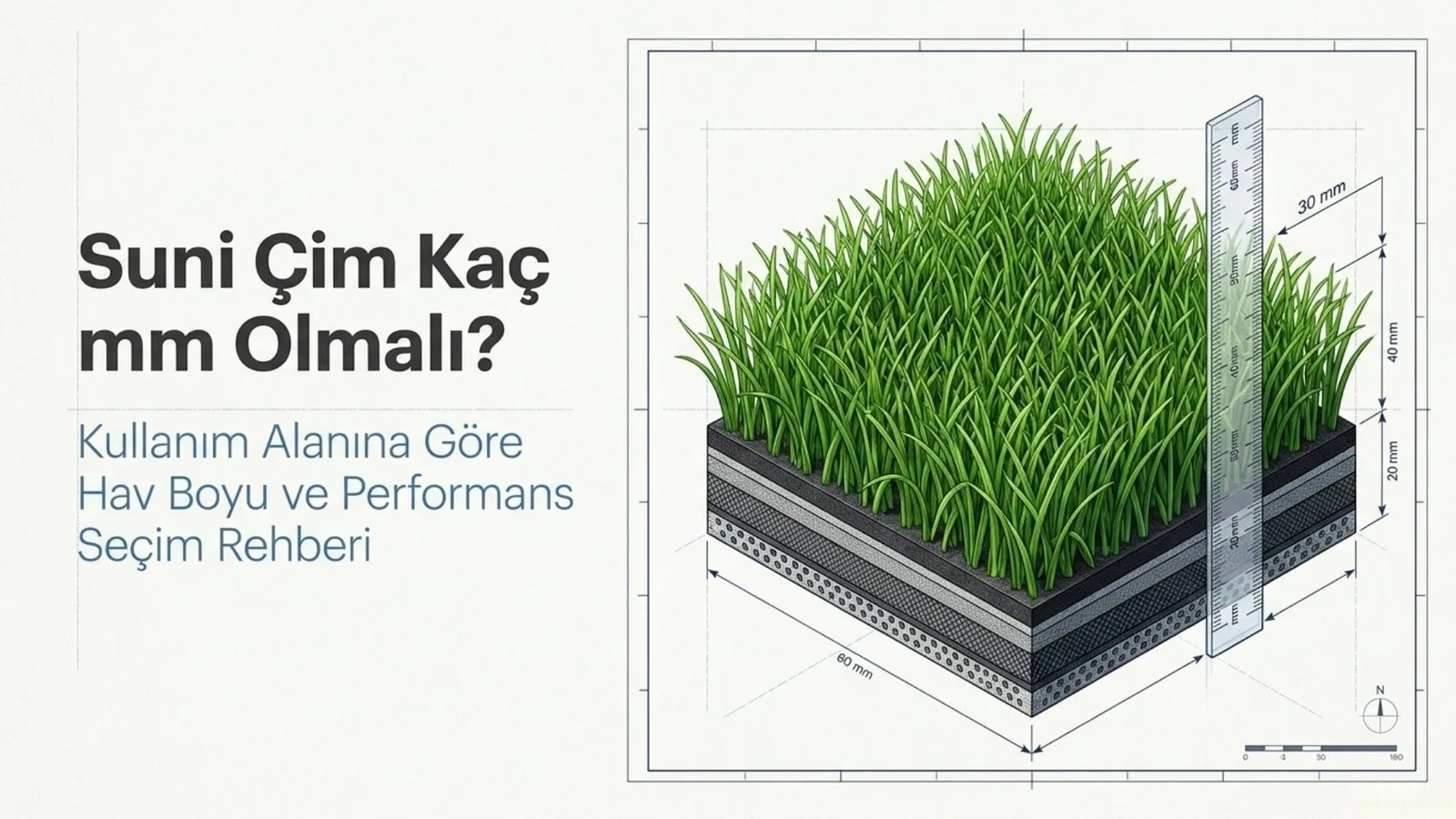
1. Pile Height: How Many mm Should Artificial Grass Be?
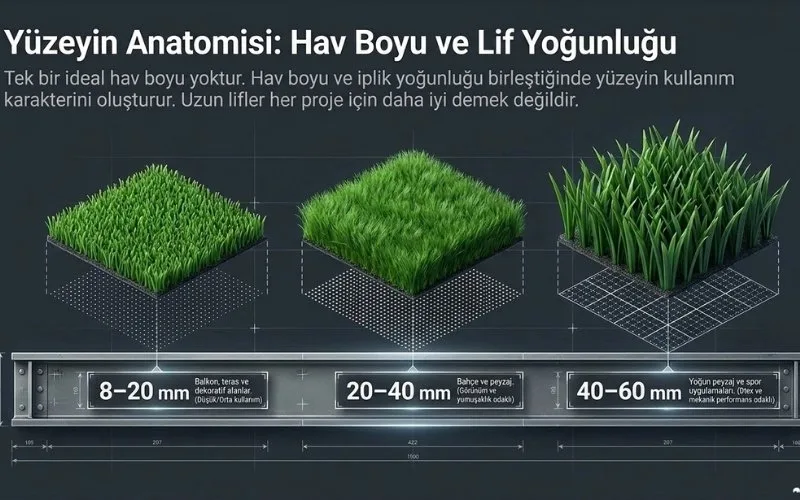
One of the most common questions in choosing artificial grass is how many millimeters the pile height should be. There is no single ideal pile height, however. Pile height should be chosen according to where the product will be used and how intensively.
Short-pile products can be practical on balconies, terraces and some decorative installations, while longer fibers may be preferred in landscaping where a natural grass look comes first. For sports products, pile height is evaluated not only for appearance but also for ball behavior and pitch performance.
| Pile Height | Typical Use | What to Watch When Choosing |
|---|---|---|
| 8–20 mm | Balconies, terraces and decorative areas | Low to medium intensity of use |
| 20–40 mm | Gardens and landscaping | Appearance, softness and density |
| 40–60 mm | High-use landscaping and sports installations | Yarn structure, dtex and purpose of use |
For example, if a landscaping project calls for a full look close to natural grass, artificial grass for garden use options can be considered. In sports projects, looking at pile height alone is not enough.
2. Yarn Type: PE or PP?

The type of synthetic yarn used in artificial grass is one of the main technical criteria that shape how the product performs in use. Landscaping and sports installations commonly use polyethylene (PE) and polypropylene (PP) yarns.
PE yarns are often chosen for products with a softer feel and a look close to natural grass. PP can offer technical and economic advantages in other applications.
However, it is not correct to make a blanket judgment such as "PE is always better" or "PP is always more durable." Yarn type should be evaluated together with dtex, fiber geometry, density, backing structure and the application area.
3. Dtex Value: Yarn Thickness and Strength
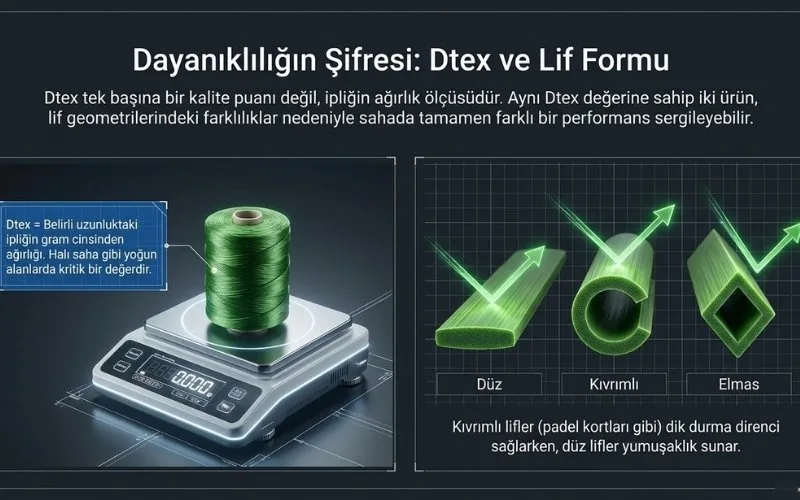
Dtex is a technical measure that expresses the weight of artificial grass yarn. Put simply, it is based on the weight of a given length of yarn. That makes the dtex value one of the important technical indicators to consider when comparing products.
Dtex becomes more important on heavily used sports surfaces. So when choosing a product for a football pitch, the dtex value, fiber structure and pitch suitability of artificial grass for football pitches should be reviewed together.
4. Fiber Density: How Much Yarn per Square Meter?
Fiber density is one of the criteria that affect the surface character and visual fullness of artificial grass. A high-density surface can look fuller, but judging the product's overall performance by density alone is not correct.
Density should be read together with dtex, pile height, tuft spacing and fiber geometry. Two artificial grass products with the same pile height can look and feel completely different because of different fiber densities.
So in the product's technical data sheet, check not only "how many mm?" but also fiber density and yarn properties.
5. What Should the Fiber Shape and Structure Be?
Artificial grass yarns can be produced in different cross-sections and shapes. Straight, curled or otherwise shaped fibers can change the product's appearance, how well it stands upright and its surface character.
Especially in landscaping where a look closer to natural grass is wanted, look not only at the color of the fibers but also at their shape and how they are distributed across the surface.
In sports installations, how the fiber shape interacts with the ball and how the surface behaves during play matter more. For example, when choosing a product for a padel court, application-specific solutions such as padel artificial grass with a curled fiber structure should be considered.
6. Backing Structure: Why Does the Back of Artificial Grass Matter?

The backing structure of artificial grass matters as much as the fibers you see on the surface. The backing system that holds the fibers in place is one of the core components of the product's overall structure.
Different backing solutions can be used in artificial grass products, latex and PU backing systems being the most common. Backing should be chosen not by material name alone but together with the product's purpose and installation conditions.
On sports pitches in particular, the backing system should be considered together with drainage, stability and the installation base. That is why it is not correct to apply the same technical expectations when comparing a sports product with a decorative landscaping product.
7. Always Check Drainage Capacity
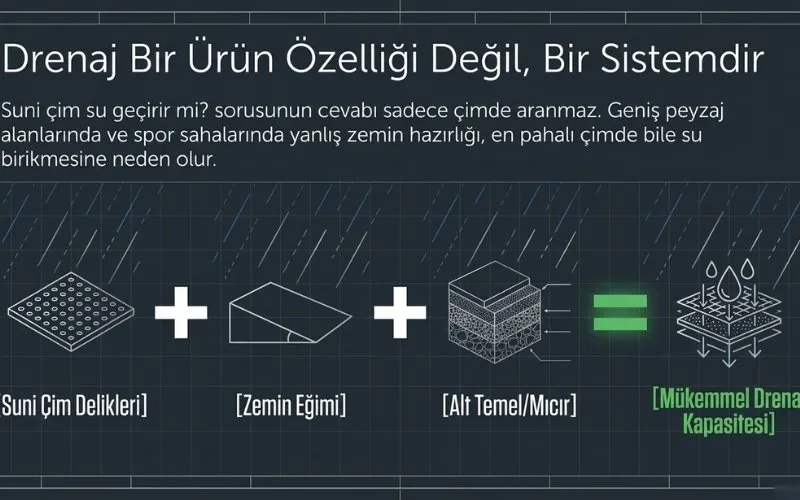
In outdoor artificial grass installations, removing rainwater from the surface is one of the critical issues. The product's drainage holes alone may not be enough; the slope of the ground, the sub-base and the water discharge system also directly affect the result.
So the question "does artificial grass let water through?" should not be answered by looking at the product alone. Product backing + ground slope + sub-base + drainage infrastructure should be evaluated together.
Especially in large gardens and landscaped areas, poor ground preparation can cause water to pool even with a good artificial grass product.
8. UV Stabilization: Why Does It Matter in Sun-Exposed Areas?
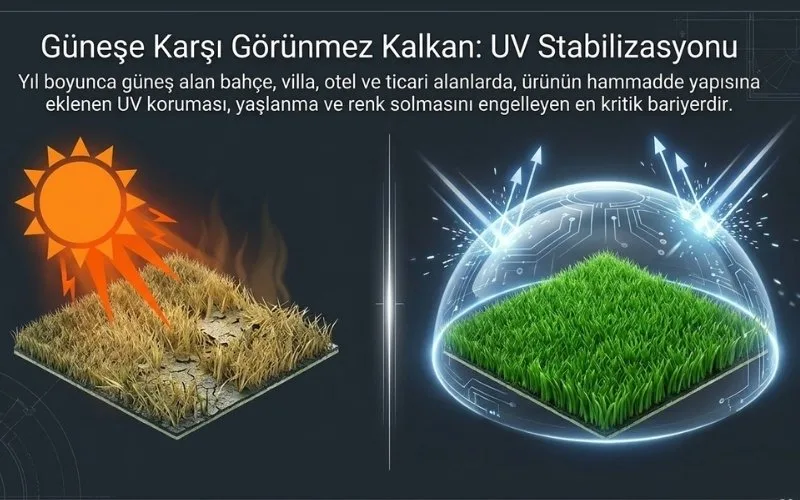
When artificial grass is used outdoors, it can be exposed to sunlight for long periods. The product's UV stabilization is therefore an important selection criterion, especially for gardens, villas, hotels and commercial areas that get sun all year round.
UV stabilization is used to support the resistance of synthetic yarns against sun-related aging and color change. Real-world performance, however, does not depend on UV stabilization alone.
Climate, hours of sun exposure, the product's raw material, intensity of use and installation conditions should be evaluated together.
9. Intensity of Use: Where Will the Artificial Grass Be Used?
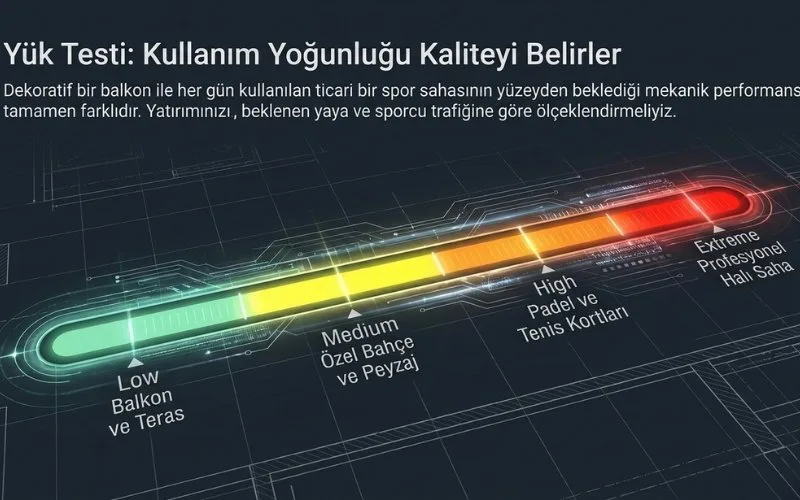
One of the most important steps in choosing the right artificial grass is determining how intensively the product will be used. A decorative balcony and a sports pitch used every day do not expect the same performance from the surface.
| Application | Priority Technical Criteria |
|---|---|
| Balcony and terrace | Appearance, softness, drainage and easy installation |
| Garden and landscaping | Natural look, fiber density, UV resistance and drainage |
| Football pitch | Yarn strength, dtex, fiber structure and pitch performance |
| Padel court | Special fiber structure, surface behavior and sports performance |
| Tennis court | Surface character, ball behavior and durability in use |
For example, when choosing a product for a tennis court, rather than applying the same criteria as for landscape artificial grass, review the properties of artificial grass for tennis court installations directly.
In choosing artificial grass for sports, it is important to evaluate the technical criteria together. Under FIFA's quality standards for football turf, artificial football surfaces are tested against different performance criteria such as player-surface interaction, ball-surface interaction, durability, weather resistance and service life.
10. Choose the Right Product for the Application Area
The last and broadest criterion in choosing artificial grass is matching the product's technical properties to the area where it will be installed. The choice should not be based on the "thickest," "densest" or "most expensive" option.
The right product is the one whose technical properties suit the purpose of use.
For example, natural look and softness come first in garden landscaping, while surface behavior and mechanical durability become more critical on professional sports surfaces.
Professional sports projects call for evaluating different products according to their purpose. For example, judging pitch-focused solutions such as Pro Odin artificial grass by the same technical criteria as decorative landscaping products will not give the right result.
Which Properties Should Be Evaluated Together When Choosing Artificial Grass?
Instead of deciding on a single technical value, evaluate all of the product's properties together. The table below can make the basic comparison easier at the buying stage.
| Criterion | Why It Matters | Enough on Its Own? |
|---|---|---|
| Pile height | Affects surface height and character in use. | No |
| Yarn type | Affects surface feel and performance in use. | No |
| Dtex | One of the technical properties of the yarn structure. | No |
| Fiber density | Affects the fullness and appearance of the surface. | No |
| Fiber shape | Plays a role in appearance and behavior in use. | No |
| Backing | Important for holding the fibers and for the system structure. | No |
| Drainage | Affects the discharge of rainwater and cleaning water. | No |
| UV stabilization | Supports resistance against sun-related aging. | No |
| Intensity of use | Determines the product performance required. | Yes, it is a core criterion |
| Application area | Guides all the other criteria in the product choice. | Yes, it is the starting criterion |
The Most Common Mistakes in Choosing Artificial Grass
A large share of wrong product choices comes from misreading technical properties. Before buying, avoid the following mistakes in particular.
- Choosing a product on price alone: A cheap product and a suitable product are not the same thing.
- Treating pile height as a sign of quality: A longer fiber is not better for every project.
- Judging dtex on its own: Fiber density and yarn shape should also be examined.
- Thinking drainage is only a product property: The ground infrastructure also determines water discharge.
- Treating landscaping and sports products as the same: The purpose of use changes the technical choice.
- Not asking about UV resistance: Sun exposure must be considered in outdoor installations.
- Miscalculating quantities: Corners, turns, waste and installation areas should be taken into account.
Can the Same Artificial Grass Be Used for a Garden, a Sports Pitch and a Commercial Space?

No. As the purpose of use changes, the priority technical criteria change too. In a garden, appearance and natural texture come first, while on sports surfaces mechanical durability, surface behavior and suitability for the sport matter more.
For example, it is not correct to judge a product developed for a football pitch in the same way as one used on a padel or tennis court. That is why the purpose of use should be clearly defined before the project starts.
The product options in Jidar Group's artificial grass category can be evaluated for different landscaping and sports applications. The priority in choosing a product should be the technical requirements of the project rather than visual similarity.
How Does Jidar Group Approach the Choice of Artificial Grass?
In choosing artificial grass, Jidar Group takes an approach that considers not only the product's appearance but also the technical requirements of the area where it will be installed. That is why evaluating products with different pile heights, yarn structures and performance properties matters in landscaping and sports installations. We install artificial grass in gardens, football pitches and sports areas in all 81 provinces of Türkiye.
In garden installations, appearance and natural texture are the priority, while on sports surfaces such as football pitches, padel and tennis courts, the product must suit the conditions of use of the sport in question.
Before deciding which pile height, yarn structure or product type suits your project, you can getproject-specific information and a quote from the Jidar Group technical team .
A Short Checklist for Choosing Artificial Grass
If you can answer all of the following questions before deciding to buy, you can compare products more reliably:
- Where will the artificial grass be used?
- How intense is daily or weekly use?
- Which pile height suits this use?
- Is the yarn type PE or PP?
- What is the dtex value?
- What is the fiber density?
- Does the fiber shape suit the purpose of use?
- What material is the backing made of?
- Are the drainage system and the installation surface suitable?
- Does the product have UV stabilization?
- Is the product meant for landscaping or for sports?
- Have the total quantity and installation conditions been calculated?
Conclusion
Choosing the right artificial grass does not mean finding the longest pile or the lowest price. A good choice comes from evaluating the application area, pile height, yarn type, dtex, fiber density, fiber shape, backing structure, drainage, UV stabilization and intensity of use together.
The technical properties needed for different projects such as gardens, balconies, terraces, football pitches, padel or tennis courts should be kept apart. Matching the product's technical data with the use scenario before buying gives a better result in terms of both performance and long-term investment.
Once you have defined the area and purpose of your project, you can review suitable artificial grass solutions from Jidar Group and reach our contact team for the technical assessment you need.
Frequently asked questions
What is the most important criterion when choosing artificial grass?
The most important starting criterion is the application area. Other properties such as pile height, yarn type, dtex, density, backing and drainage should be evaluated according to the purpose of use.
Which matters more in artificial grass, pile height or dtex?
The two describe different properties, and neither should be considered more important than the other on its own. Pile height is used to assess the character in use, and dtex to assess the technical properties of the yarn structure.
Is longer-pile artificial grass higher quality?
No. A long pile is not an advantage for every project. The product's purpose of use, fiber structure, density and dtex value should be evaluated together.
Why does drainage matter when choosing artificial grass?
In outdoor installations, rainwater and cleaning water must be removed from the surface. For that, the ground slope and the sub-base system must be suitable as well as the product's drainage structure.
Can artificial grass used in gardens be used on a football pitch?
This cannot be assumed for every product. On sports pitches, the product needs technical properties suited to the conditions of use of the sport in question.
Should you choose PE or PP artificial grass?
The choice should be based on the purpose of use. Yarn type should be evaluated together with dtex, fiber shape, density, backing and the expected conditions of use.
Is it right to look only at price per square meter when buying artificial grass?
No. Besides price per square meter, compare pile height, dtex, fiber density, yarn type, backing, UV resistance and suitability for the application area.

0 comments
Leave a comment
Your comment will be published after review.