

Summarize this article with AI Open a summary of this article in your preferred assistant
Around a factory, grass fence is attached to a chain link or panel fence to mark the plot boundary and hide open storage, loading and machinery areas from outside view. Height depends on use: 100–120 cm for interior separation, 150 cm for general site perimeters, 200 cm for high privacy. Planning should account for gate openings, forklift and truck routes, wind load and post strength.
Using grass fence around factories and business premises is one of the perimeter options chosen to mark site boundaries, reduce visibility from outside and create a tidier look around the facility. At production plants, open storage yards, logistics areas, warehouses and corporate sites in particular, grass fence combines a wire base with natural-looking screening.
At industrial sites, grass fence should not be chosen on looks alone. The purpose of the site, the length of the line to be fenced, the level of privacy needed, vehicle traffic, gate openings, ground conditions and the existing wire base all need to be assessed together. Grass fence systems can be adapted to different installation scenarios based on these criteria.
Jidar Group manufactures grass fence at its facility in Arnavutköy, Istanbul; for factory and business perimeters, we plan height, dimensions and installation together according to project conditions. The aim is not only to close off the area but to build a perimeter that suits how the site is used.
When choosing grass fence for a factory perimeter, look beyond appearance: the security boundary, privacy, wire base, post structure, intensity of use and installation conditions all need to be considered together.
Why Is Grass Fence Used Around Factories?
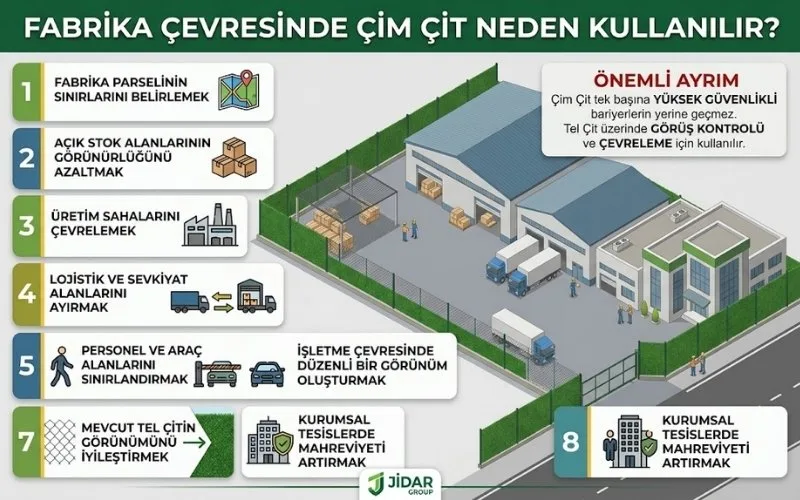
Factories and industrial plants often operate on large plots. Marking the boundary of these areas may not be enough. Reducing the visibility of open storage areas, separating production zones and tidying up the outward appearance of the facility also matter.
Here, grass fence can be considered as a way to add visual screening to a chain link fence base.
- Marking the boundaries of the factory plot
- Reducing the visibility of open storage areas from outside
- Enclosing production areas
- Separating logistics and shipping areas
- Defining staff and vehicle areas
- Creating a tidier look around the business
- Improving the appearance of an existing wire fence
- Increasing privacy at corporate facilities
There is an important distinction here. On its own, grass fence does not replace the special security barriers used at high-security facilities. It is mainly used on an existing wire fence or a suitable supporting structure for sight control and enclosure.
Where Is Grass Fence Used Around a Factory?
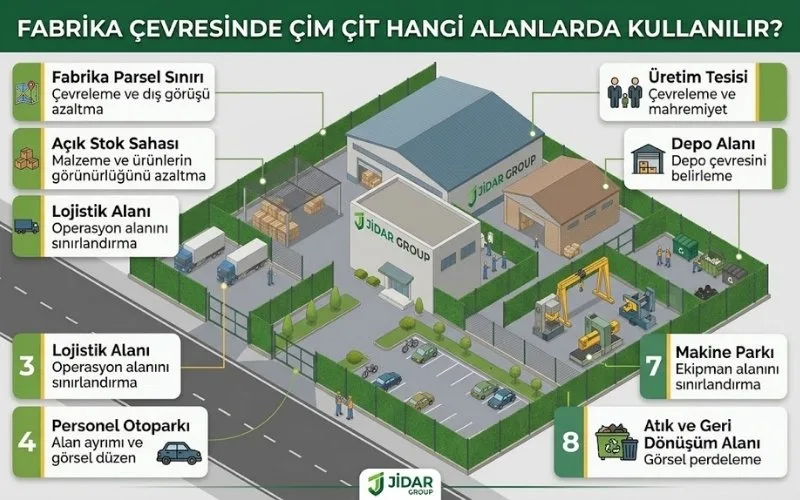
Grass fence does not have to be limited to the main boundary of the factory. It can also be used inside the site to separate different areas of use.
| Area | Main Function of the Grass Fence |
|---|---|
| Factory plot boundary | Enclosure and reducing outside view |
| Open storage yard | Reducing the visibility of materials and products |
| Logistics area | Defining the operations area |
| Staff parking | Area separation and visual order |
| Production plant | Enclosure and privacy |
| Warehouse area | Marking the warehouse perimeter |
| Machinery yard | Defining the equipment area |
| Waste and recycling area | Visual screening |
Grass Fence for Open Storage Yards
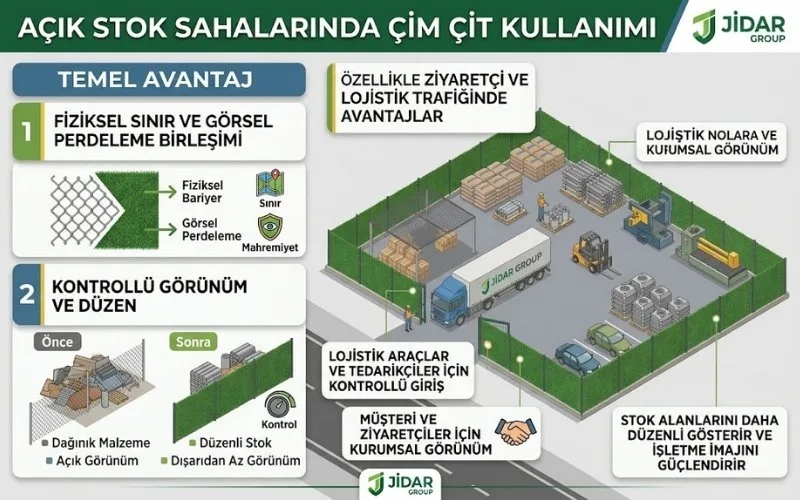
Factories may keep raw materials, semi-finished goods, pallets, metal products or materials awaiting shipment in open storage yards. Enclosing these areas with a standard chain link fence creates a physical boundary but may not stop the materials inside from being seen from outside.
This is where grass fence takes on a second role. In addition to the enclosure provided by the wire base, it partly limits the view and helps the storage area look more orderly.
The main advantage of grass fence in open storage yards is that it combines a physical boundary and visual screening in a single installation.
At facilities where customers, suppliers and logistics vehicles enter regularly, a more controlled look for storage areas can be an advantage for the business.
Does Grass Fence Provide Security Around a Factory?
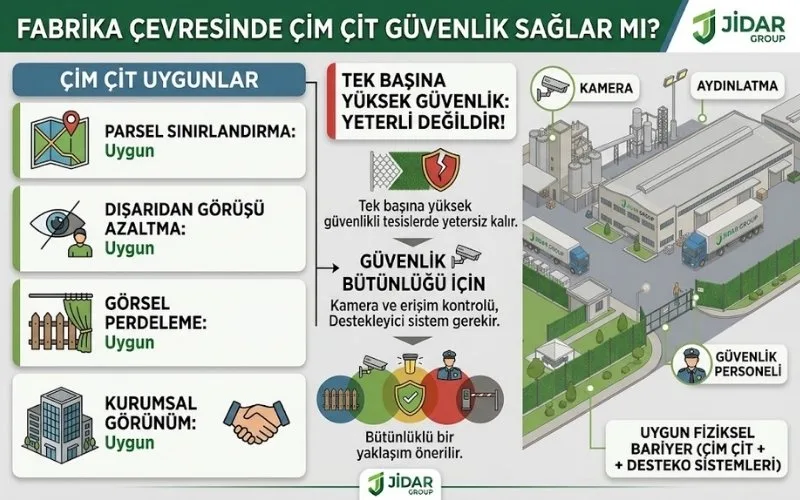
Security needs to be defined correctly for grass fence installations. The supporting wire and post system of a grass fence helps mark the site boundary. The grass covering on it reduces the view from outside.
However, at facilities that require high security, grass fence should not be treated as a security system on its own.
| Need | Role of the Grass Fence |
|---|---|
| Marking the plot boundary | Suitable |
| Reducing outside view | Suitable |
| Visual screening | Suitable |
| Corporate appearance | Suitable |
| High security on its own | Not sufficient |
| Cameras and access control | Supporting systems required |
For this reason, grass fence around a factory can be planned together with cameras, lighting, controlled gates, security staff and suitable physical barriers.
How Tall Should a Grass Fence Be for a Factory?

The height of a grass fence around a factory should not be set by looks alone. The location of the area and the level of screening expected also need to be taken into account.
| Approximate Height | Suitable Use |
|---|---|
| 100 cm | Interior area separation and low-level enclosure |
| 120 cm | Parking, landscaping and limited area separation |
| 150 cm | General business and facility perimeters |
| 200 cm | Higher privacy and control of outside view |
For example, the staff parking lot inside a factory may not need the same height as the plot boundary. So instead of using a single size across the project, each area can be assessed by its use.
Where standard sizes do not suit the site or project conditions, custom-size grass fence options can be considered.
Which Technical Features Matter When Choosing Grass Fence for a Factory?
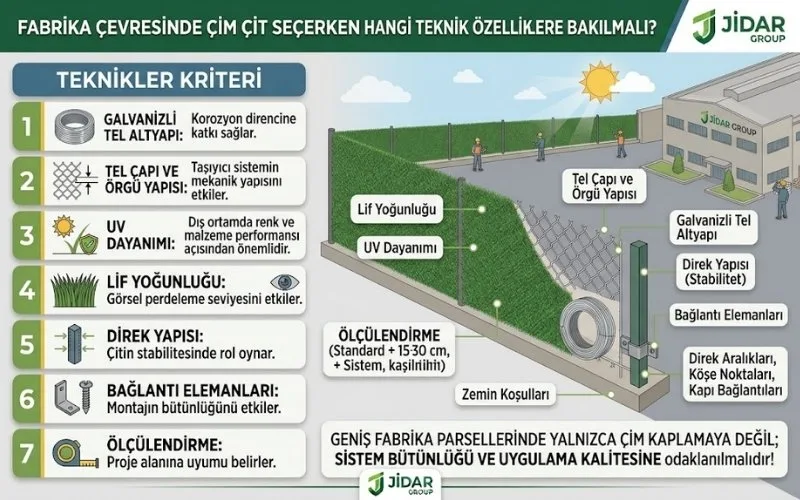
For industrial use, it is not enough for a grass fence to simply look green. The supporting structure, covering material and installation method need to be assessed together.
| Technical Criterion | Why It Matters |
|---|---|
| Galvanized wire base | Contributes to corrosion resistance |
| Wire diameter and mesh structure | Affects the mechanical structure of the supporting system |
| UV resistance | Important for color and material performance outdoors |
| Fiber density | Affects the level of visual screening |
| Post structure | Plays a role in fence stability |
| Fasteners | Affect the integrity of the installation |
| Sizing | Determines the fit with the project area |
On large factory plots in particular, focusing only on the quality of the grass covering is a mistake. Post spacing, corner points, gate connections and ground conditions also affect how the project performs.
Grass Fence vs. Panel Fence Around a Factory

For factory perimeters, panel fence and grass fence do not meet the same need. The choice should weigh security, visibility and appearance together.
| Criterion | Grass Fence | Panel Fence |
|---|---|---|
| Reducing view | High | Low |
| Natural look | High | Low |
| Wire base | Yes | Yes |
| Fit with corporate landscaping | High | Medium |
| Screening open storage areas | Advantageous | Limited |
| High-security requirement | Depends on project | Depends on project |
If reducing the factory's visibility from outside is important, grass fence may stand out. If the view should stay open and only the boundary needs marking, panel fence may be more suitable.
So before asking “which product is better?”, first define what need the site is being fenced for.
Visual Privacy with Grass Fence at Factories and Businesses
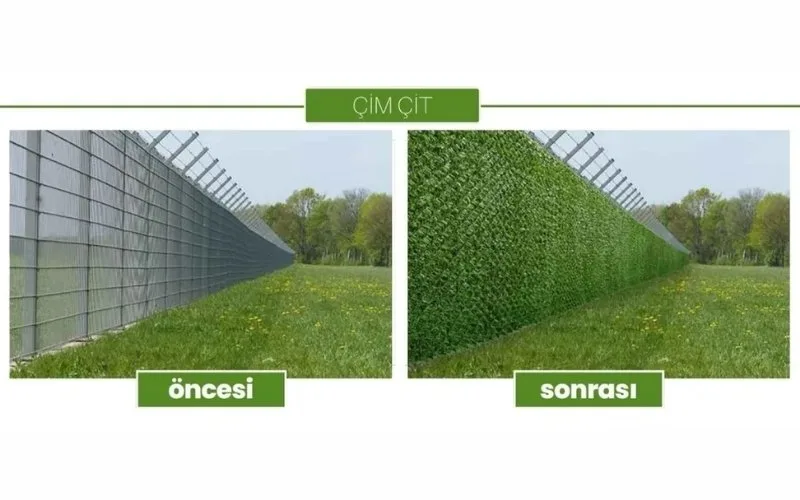
At production facilities, some operations may be better kept out of sight. Machinery yards, storage areas, loading zones and production support areas are examples.
In these areas, grass fence can be used to reduce visibility without building a fully closed wall.
This matters especially for factories located within cities. The visual relationship between the facility and the road, sidewalk or neighboring plot can be made more controlled.
Grass fence is one of the perimeter options that can provide visual privacy around a factory without the effect of a fully closed wall.
Planning Grass Fence at Factories with Forklift and Vehicle Traffic
The fence line around a factory should not be thought of only as a fixed boundary. The movements of forklifts, trucks, tractor-trailers and service vehicles should also be included in project planning.
In loading and unloading zones especially, it is important to leave enough distance between the fence line and vehicle maneuvering areas.
- Truck entry and exit points should be defined.
- Forklift routes should be taken into account.
- The swing areas of loading gates should be checked.
- The risk of vehicle impact at corners should be assessed.
- Pedestrian crossings and vehicle roads should be kept separate.
- Protective barrier solutions should be planned separately where needed.
Placing the fence line too close to vehicle traffic can increase the risk of mechanical damage, however good the product is.
Planning Grass Fence and Gates at Factory Entrances
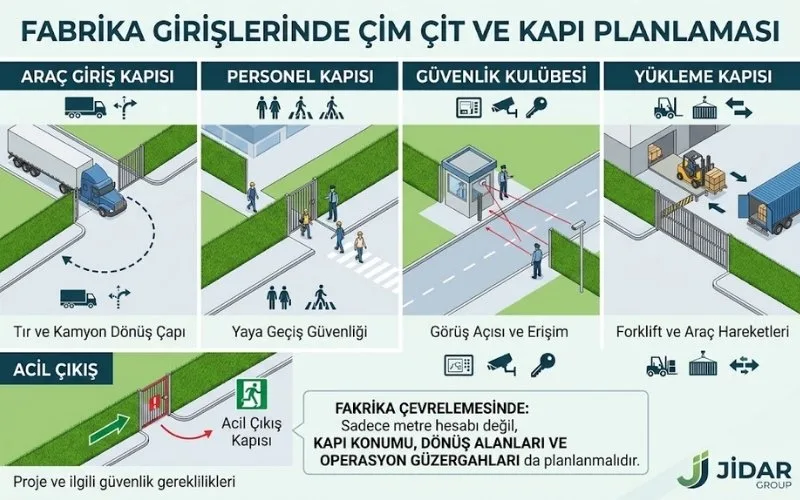
Gate openings are among the most critical points of a grass fence installation. Because factory entrances carry vehicle and pedestrian traffic, the fence line and gate system should be planned together.
| Zone | What to Watch For |
|---|---|
| Vehicle entrance gate | Turning radius of tractor-trailers and trucks |
| Staff gate | Pedestrian safety |
| Security booth | Line of sight and access |
| Loading gate | Forklift and vehicle movements |
| Emergency exit | Project and applicable safety requirements |
So when fencing a factory, do not calculate only the total length in meters. Gate positions, turning areas and operating routes should also be measured.
How to Choose the Color of a Grass Fence for a Factory

At industrial sites, color is not always a matter of personal taste. The factory's architecture, facade colors, landscaping and corporate look can also be considered.
Classic green grass fence blends easily with natural landscaping, while businesses with more modern architecture may prefer anthracite grass fence.
If a corporate or decorative result different from the standard green look is wanted, colored grass fence options can also be considered.
The basic aim is to match the fence color to the factory's facade and surroundings.
Can Leaf Grass Fence Be Used Around a Factory?

Leaf models can be considered where a more decorative, natural look is wanted around a business. Around administrative buildings, visitor entrances, social facilities and areas that blend with landscaping, they can create a different visual character.
Leaf grass fence can be used where a denser decorative look with a leaf texture is wanted instead of the classic grass look.
However, in heavy industrial yards, vehicle traffic zones and security-priority areas, the product should be chosen primarily on technical and operational needs.
Grass Fence in Industrial Zones
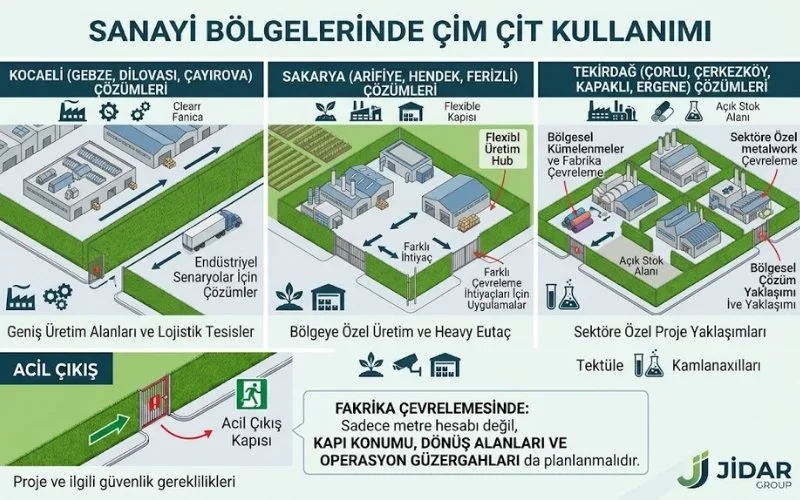
A large share of factory fencing projects take place in organized industrial zones and dense manufacturing clusters. In these zones, a business's fencing needs can vary by use: factory, warehouse, logistics center, open storage area or production campus.
At facilities in industrial zones such as Gebze, Dilovası and Çayırova in Kocaeli, Arifiye and Hendek in Sakarya, and Çorlu, Çerkezköy and Kapaklı in Tekirdağ, fencing needs are assessed together with large production and logistics areas. We install grass fence in all 81 provinces of Türkiye, including these; details are on the service areas page.
What Determines the Cost of Grass Fence Around a Factory?
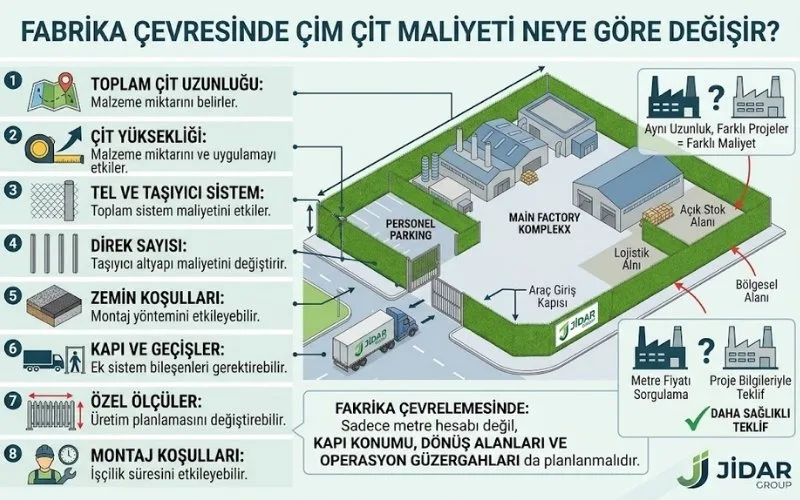
The cost of grass fence around a factory should not be judged by the meter alone. Two projects of the same length can differ in ground, height, posts, gates and installation conditions.
| Cost Factor | Effect on Cost |
|---|---|
| Total fence length | Determines the quantity of material |
| Fence height | Affects material quantity and installation |
| Wire and supporting system | Affects total system cost |
| Number of posts | Changes the cost of the supporting structure |
| Ground conditions | May affect the installation method |
| Gates and openings | May require additional system components |
| Custom sizes | May change production planning |
| Installation conditions | May affect labor time |
So when pricing grass fence around a factory, sharing the project details rather than asking only for a “price per meter” leads to a more reliable quote.
How Is a Factory Grass Fence Project Planned?
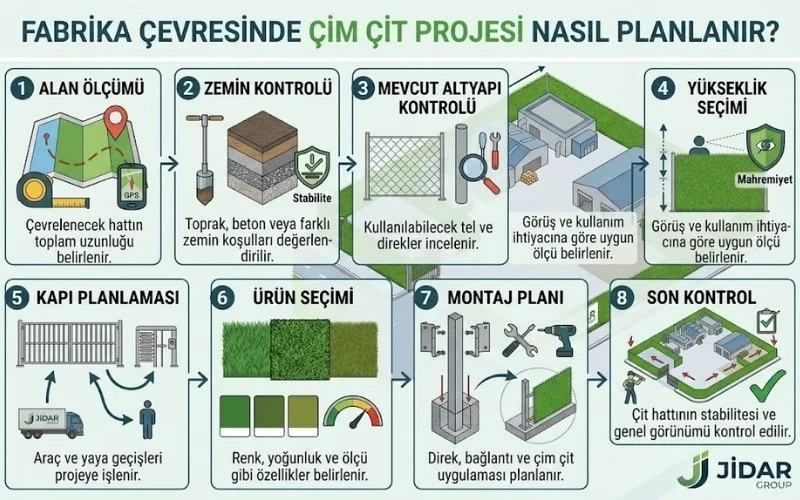
In a professional installation, the process does not start with product selection. First, the purpose of the area to be fenced is defined.
- Site measurement: The total length of the fence line is determined.
- Ground check: Soil, concrete or other ground conditions are assessed.
- Existing structure check: Wire and posts that can be reused are inspected.
- Height selection: The right size is set according to view and use requirements.
- Gate planning: Vehicle and pedestrian openings are added to the project.
- Product selection: Features such as color, density and size are chosen.
- Installation plan: Posts, fasteners and grass fence installation are planned.
- Final check: The stability and overall look of the fence line are checked.
Advantages of Grass Fence Around a Factory
Helps make factory boundaries clearer.
Reduces the view from outside.
Limits the visibility of open storage areas.
Creates a tidier look around the business.
Can blend with landscaping.
Can come in different height and color options.
Can be used with suitable existing wire structures.
Can be installed modularly on large factory plots.
With the right materials and installation, can be made suitable for outdoor use.
Jidar Group's Approach to Factory and Business Perimeters
Jidar Group manufactures grass fence at its facility in Bolluca, Arnavutköy, Istanbul. With an annual serial production capacity of 500,000 m², we handle large-volume orders. We provide grass fence installation in all 81 provinces of Türkiye.
For standard installations, different height options are considered; when project dimensions do not fit standard systems, custom-size options can also be planned.
Your grass fence need may be a factory boundary, open storage area, logistics center, warehouse or corporate site. Share your project's length in meters, height and installation conditions through the Jidar Group contact page to request a technical assessment and quote.
Conclusion: When Should Grass Fence Be Chosen for a Factory?
Grass fence around factories and business premises can be considered for projects that need a boundary and also want less visibility from outside and a tidier facility appearance.
It can be especially useful around open storage yards, production areas, logistics zones and corporate facilities. For the right result, however, look not only at the product's appearance but also at the wire base, post system, height, UV resistance, ground conditions and installation method together.
Jidar Group's manufacturer-based, project-focused approach allows factory and business fencing needs of different scales to be assessed according to how the site will be used.
Frequently asked questions
Why is grass fence used around factories?
Around factories, grass fence can be used to mark the site boundary, reduce the view from outside, screen open storage areas and create a tidier look around the business.
Is grass fence enough for factory security?
Grass fence should not be treated as a high-security system on its own. It provides enclosure and visual screening. At facilities that need high security, it should be planned together with cameras, lighting, controlled gates and suitable physical security systems.
How tall should a grass fence be around a factory?
The required height depends on how the site is used. Options such as 100, 120, 150 and 200 cm can be considered for different fencing needs. For open storage or high privacy, taller systems may be preferred.
Can grass fence be used around a factory's open storage area?
Yes. In open storage areas, grass fence can be added to a wire fence base to reduce the view from outside and help the storage area look more orderly.
Can grass fence be installed on an existing factory wire fence?
If the existing wire fence is structurally sound, grass fence can be installed on it. However, the strength of the wire, posts and connection points should be checked before installation.
What is the difference between grass fence and panel fence around a factory?
Compared with panel fence, grass fence is more effective at reducing the view from outside and giving a natural look. Panel fence may be preferred where the view should stay open.
Can grass fence be used at factories with forklift traffic?
Yes. However, the fence line should be planned around forklift, truck and tractor-trailer routes. The risk of impact should be assessed separately, especially in loading areas and tight maneuvering zones.
Can anthracite grass fence be used around a factory?
Yes. Anthracite grass fence can be considered at factories with modern facades and at corporate businesses so that the perimeter matches the architecture.
Can custom-size grass fence be used around a factory?
Yes. When site dimensions or project requirements do not fit standard sizes, custom-size grass fence options can be considered. Setting dimensions per project makes material and installation planning easier.
How is the price of grass fence around a factory calculated?
The price can vary with total length in meters, height, the wire and post structure, ground conditions, gate openings, custom sizes and installation conditions. For a reliable quote, the project dimensions need to be assessed together.

0 comments
Leave a comment
Your comment will be published after review.