An awning that does not need a wall
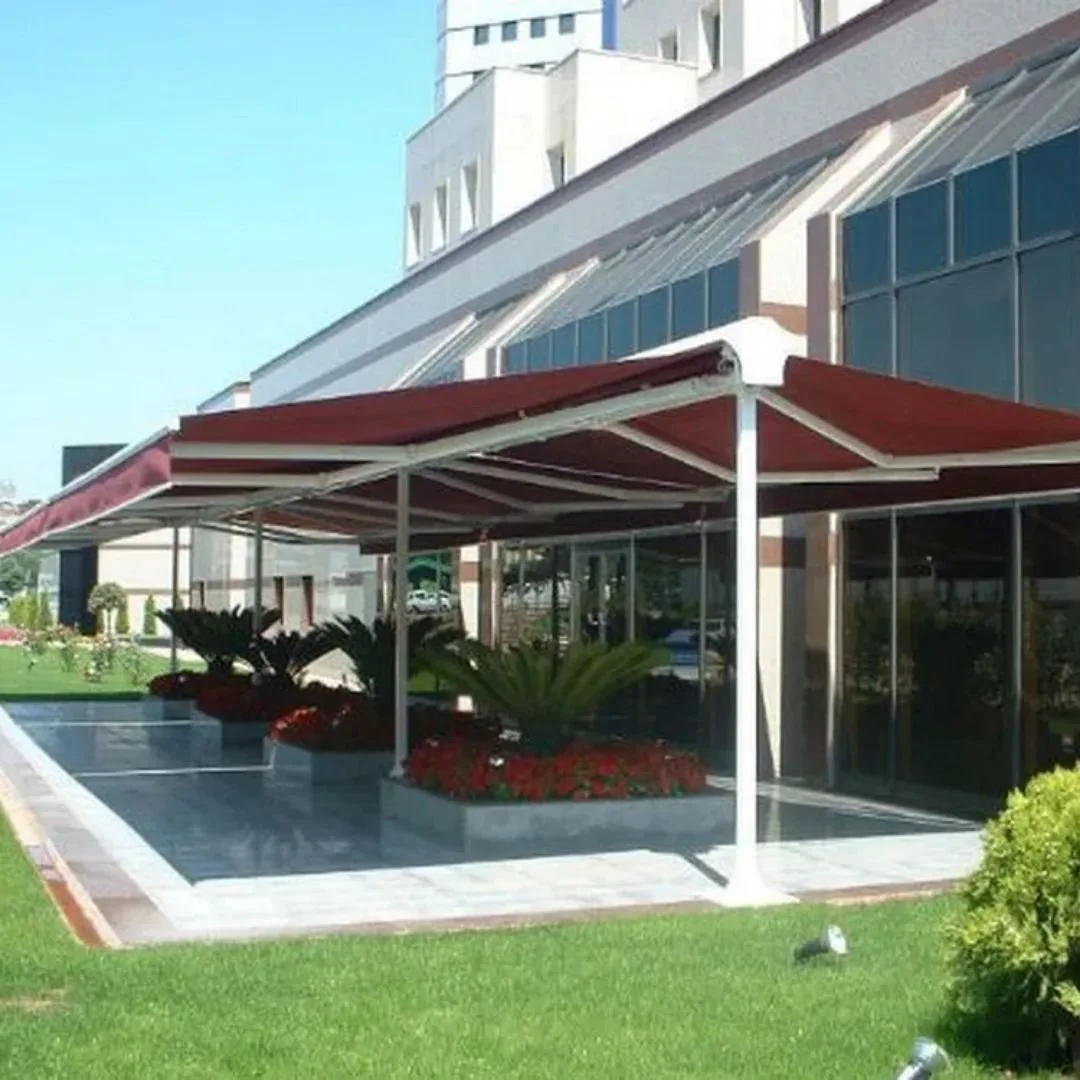
A freestanding awning carries its weight on a steel post frame anchored to the ground, not on the facade. PVC-coated polyester tarpaulin is stretched over the top of the frame. Use it where there is no wall to fix to. It also suits buildings where fixing an awning to the facade is not allowed.
You will most often see it in tea and cafe gardens, parking lots, school yards, waiting areas and open sales areas. The width of the area sets how many posts you need and how far apart they stand. With a single row of posts, the awning slopes in one direction. With a double row, it slopes in two directions.
Highlights
- Self-supporting: Nothing is fixed to the facade, so there is no need to drill into insulated or rented buildings.
- Length: The awning is extended by adding rows of posts.
- Custom frame: A frame sized to the site is made through our Steel Structure Fabrication service.
Ground and rainwater
The posts are fixed to concrete with anchor bolts and base plates. On soil, a concrete footing is poured under each post. Plan from the start where rainwater from the sloped edge of the awning will drain. Set the slope so the water does not pour onto the seating area or walkway. In a parking lot, position the posts so car doors can open easily.
For an awning on a sidewalk or public land, get a municipal permit. For models that open and close, see the Bat Wing Awning and Retractable Bellows Awning pages. For a fixed roof over a seating area, see the Garden Gazebo Tent page. For a quote, send us the dimensions of the area.